
Gli autori, in questo interessante report sulle acque del Tevere, si esprimono attraverso curiosi parallelismi sui pesci insidiabili (muggini e cavedani) e le tecniche di pesca (mosca e euronymph). Buona lettura.
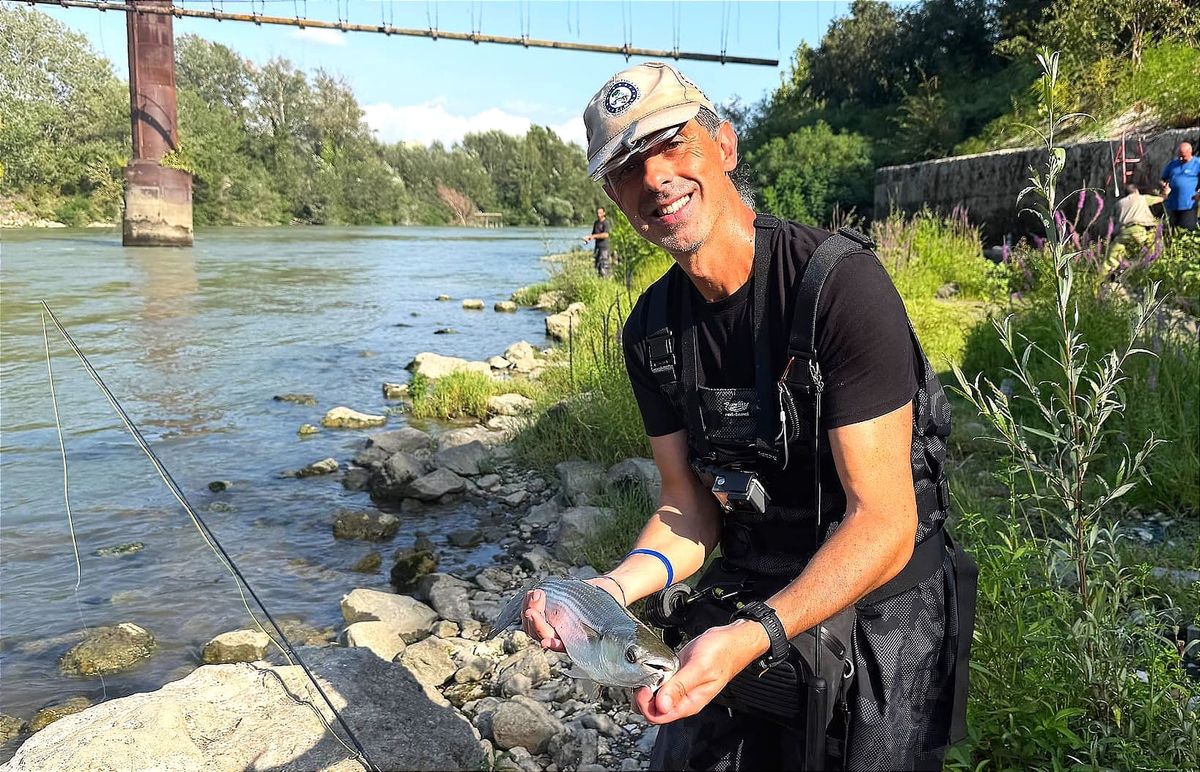
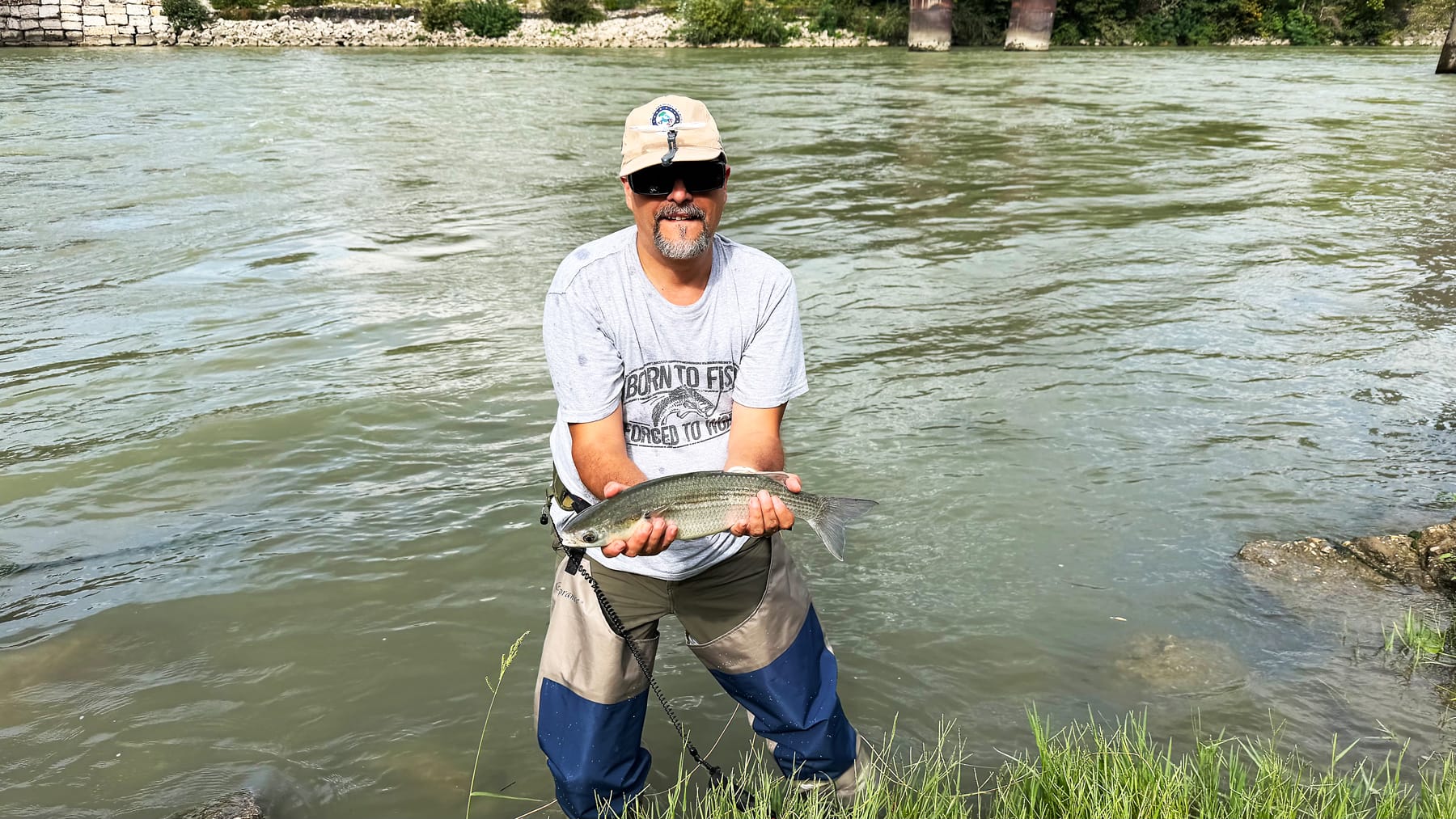
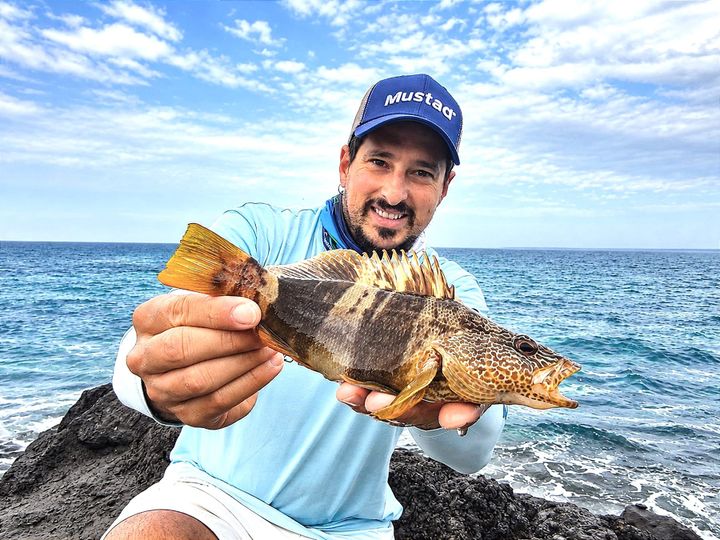
foto in alto: Marco con un bel ramada catturato vicino al vecchio ponte di Castel Giubileo.
Cefali e cavedani, qual è il trait d’union tra questi due pesci? Appartengono a famiglie diverse (rispettivamente Mugilidi e Ciprinidi), i primi sono eurialini, i secondi sono strettamente dulcicoli, i cefali spesso vivono in banchi mentre i cavedani, soprattutto in età adulta, sono solitari. Hanno però alcune caratteristiche comuni: la silhouette, tipica di pesci che possono vivere in corrente, la livrea argentata, che suggerisce la loro permanenza principalmente in acque superficiali, e da ultimo il loro nome, che ne indica la grossa testa. “Cefalo” deriva dal greco kephalē, “cavedano” ha origine dal latino capito, che entrambi significano “testa grossa”. In questa occasione non intendiamo entrare nel merito di questioni tassonomiche (esistono infatti più specie di cefali e cavedani), ma dedicare l’articolo a due tecniche del fly fishing, l’euronymph e la mosca classica (la cui differenza principale sta nel modo in cui l'esca viene presentata in acqua) che, nel Tevere capitolino, rendono al meglio per la cattura di questi due pesci.
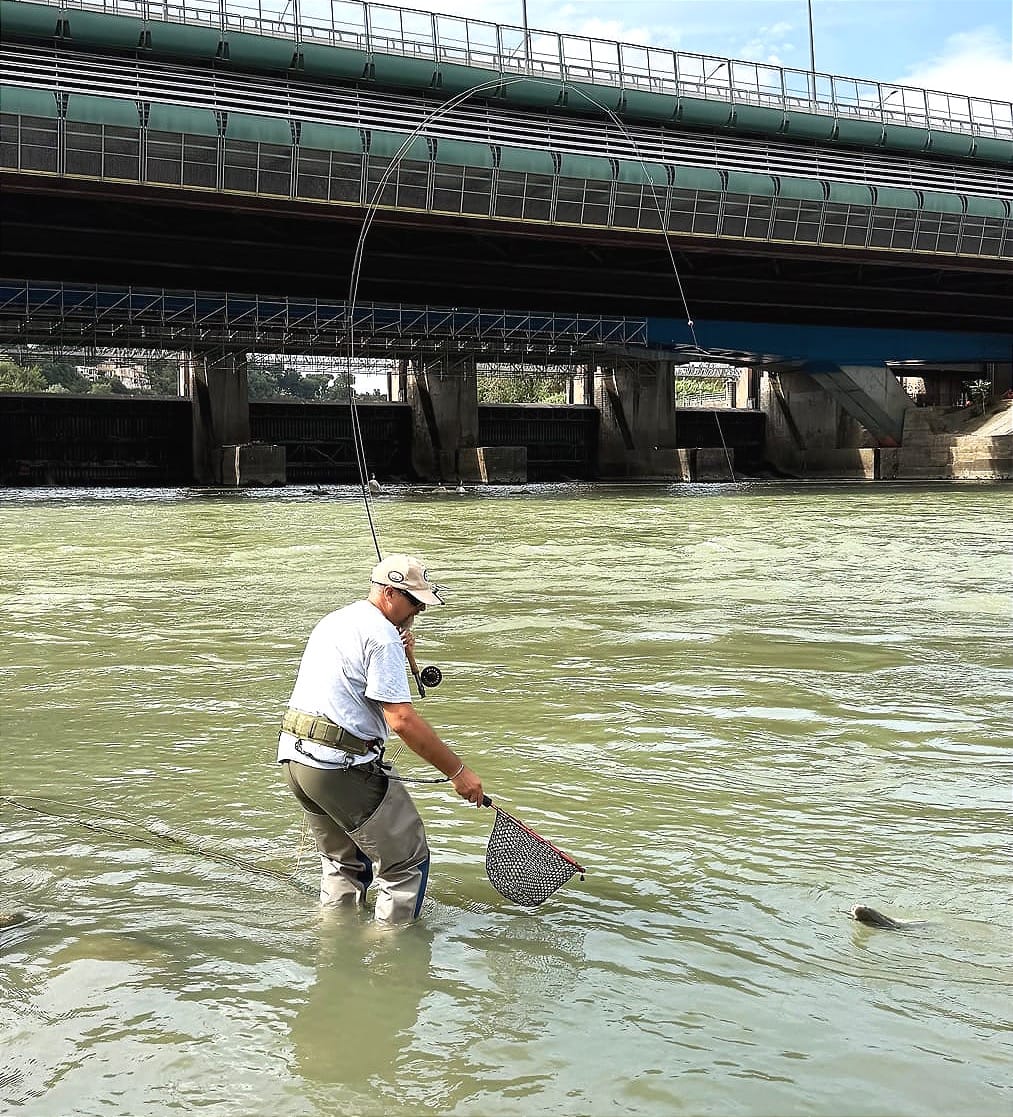
Euronymph (by Francesco Falessi) - C’è un luogo a Roma dove il fascino imponente dell’archeologia industriale e urbana si fonde in modo sorprendente con una natura florida. Ci troviamo nella periferia nord della Capitale, precisamente nel tratto del Tevere situato immediatamente a valle della diga di Castel Giubileo. È uno spot urbano fuori dagli schemi, capace di garantire il massimo divertimento a qualunque appassionato grazie a una biodiversità ittica strabiliante. Qui possiamo trovare Ciprinidi, tra cui carpe imponenti, barbi combattivi, cavedani smaliziati, aspi voraci, e poi tante breme, gardon e carassi. Non mancano neanche grandi predatori, quali il siluro e il lucioperca. Ma ciò che rende davvero unico questo tratto è la presenza stagionale di pesci marini: in tarda primavera assistiamo alla risalita delle cheppie, affiancate da un massiccio numero di cefali - principalmente il cefalo calamita (Chelon ramada), il più eurialino della famiglia, riconoscibile per una macchia nera alla "ascella" delle pettorali - e, di tanto in tanto, da qualche spigola. Per la nostra battuta abbiamo scelto di pescare sulla riva destra, la cui sponda digrada dolcemente verso il centro dell’alveo grazie ai detriti trasportati dal fiume Cremera, che si immette in questo punto creando un micro habitat ideale per richiamare i pesci. Alzando gli occhi verso la sponda op-posta, il panorama regala suggestioni storiche uniche: i grandi piloni, i tiranti e i resti ancora visibili del vecchio ponte ferroviario, bombardato durante la II Guerra Mondiale, fanno da muti testimoni alle nostre sferzate. In questo tratto siamo andati con Marco alla ricerca di potenti e indomabili cefali. Ma non lo abbiamo fatto con la classica canna bolognese, né a spinning. Oggi affrontiamo Castel Giubileo con l’euronymph. In questa tecnica, che prevede micro code o nylon diretto, il filo è teso e quasi tutto fuori dall'acqua; non ci sono pance di lenza a disturbare la corrente.
Attrezzatura - L'attrezzatura usata è leggera: canna da 10 piedi abbinata a una coda DT #2. Il finale di nylon utilizzato si discosta un po’ dai canoni dell’euronymph; infatti, è conico oppure strutturato a tre spezzoni, con diametri a scalare, lungo quanto la canna. Il tippet è costituito da 120 centimetri di nylon del diametro 0,18-0,20. Il montaggio prevede la pesca con doppia ninfa. In punta montiamo l'esca più pesante, mentre su un bracciolo di cm 15 circa, posizionato a 60-70 centimetri dalla ninfa di testa, leghiamo la seconda imitazione. Per questa pescata abbiamo optato per due modelli autocostruiti: in punta una ninfa San Juan dai toni arancio, mentre sul bracciolo una ninfa Baetis scura. Per facilitare la percezione dell’abboccata utilizziamo un piccolo strike indicator oppure cm 30 di nylon bicolore inseriti a circa 150 centimetri dalla ninfa di testa.
Tecnica - L’azione di pesca viene condotta in stile euronymph: la canna guida e anticipa costantemente la passata per mantenere la vetta in perfetto contatto con le esche, cosa resa spesso complicata dalla forte corrente del fiume. La tensione nel braccio deve essere costante, pronta a ferrare al minimo stop del filo per evitare che gli scaltri cefali sputino l'inganno. L'impostazione paga fin dai primi lanci e gli attacchi non si fanno attendere: a far piegare il carbonio della 10 piedi sono dei grossi cefali, che regalano fughe energiche prima di finire nel guadino.
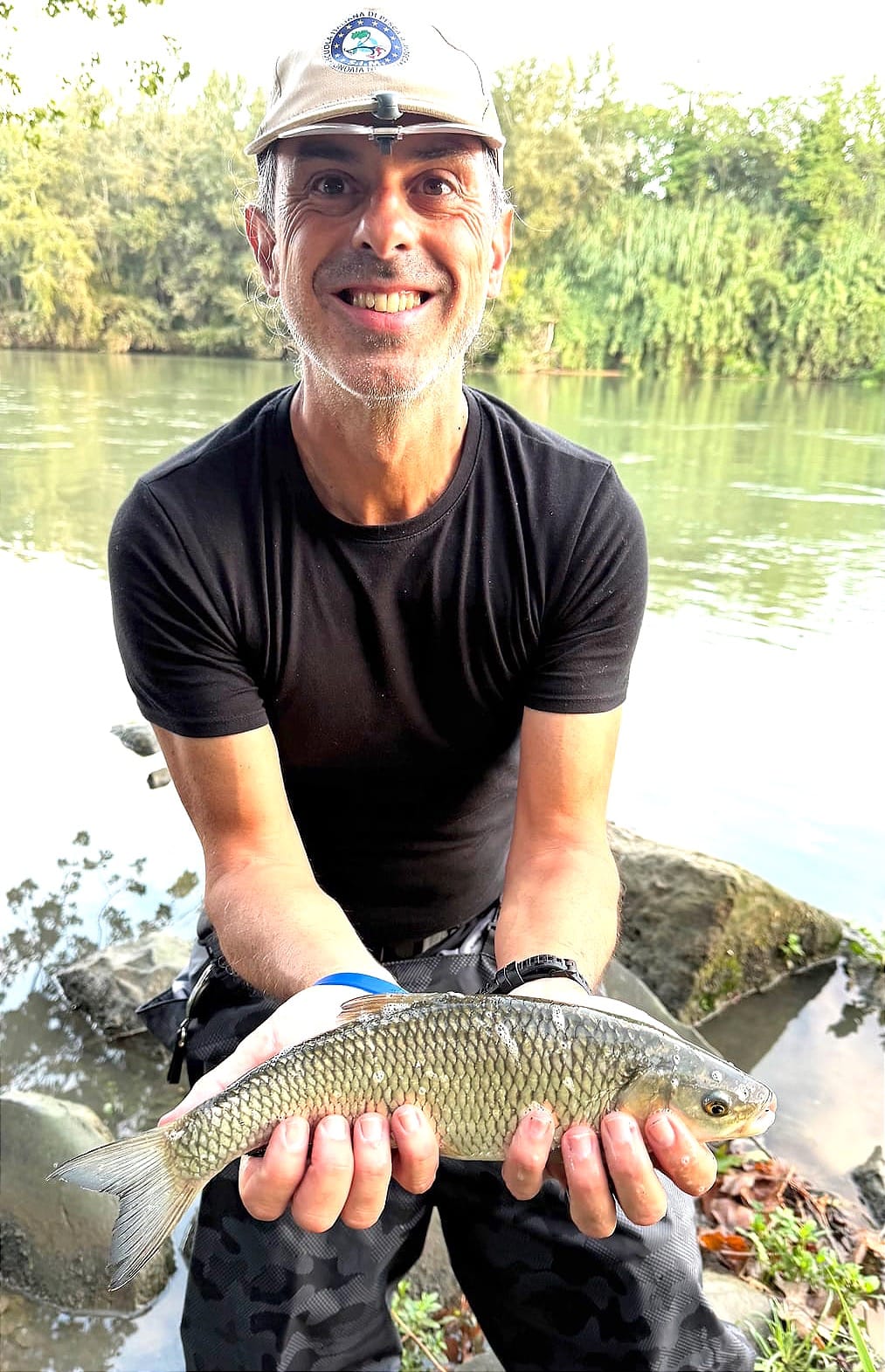
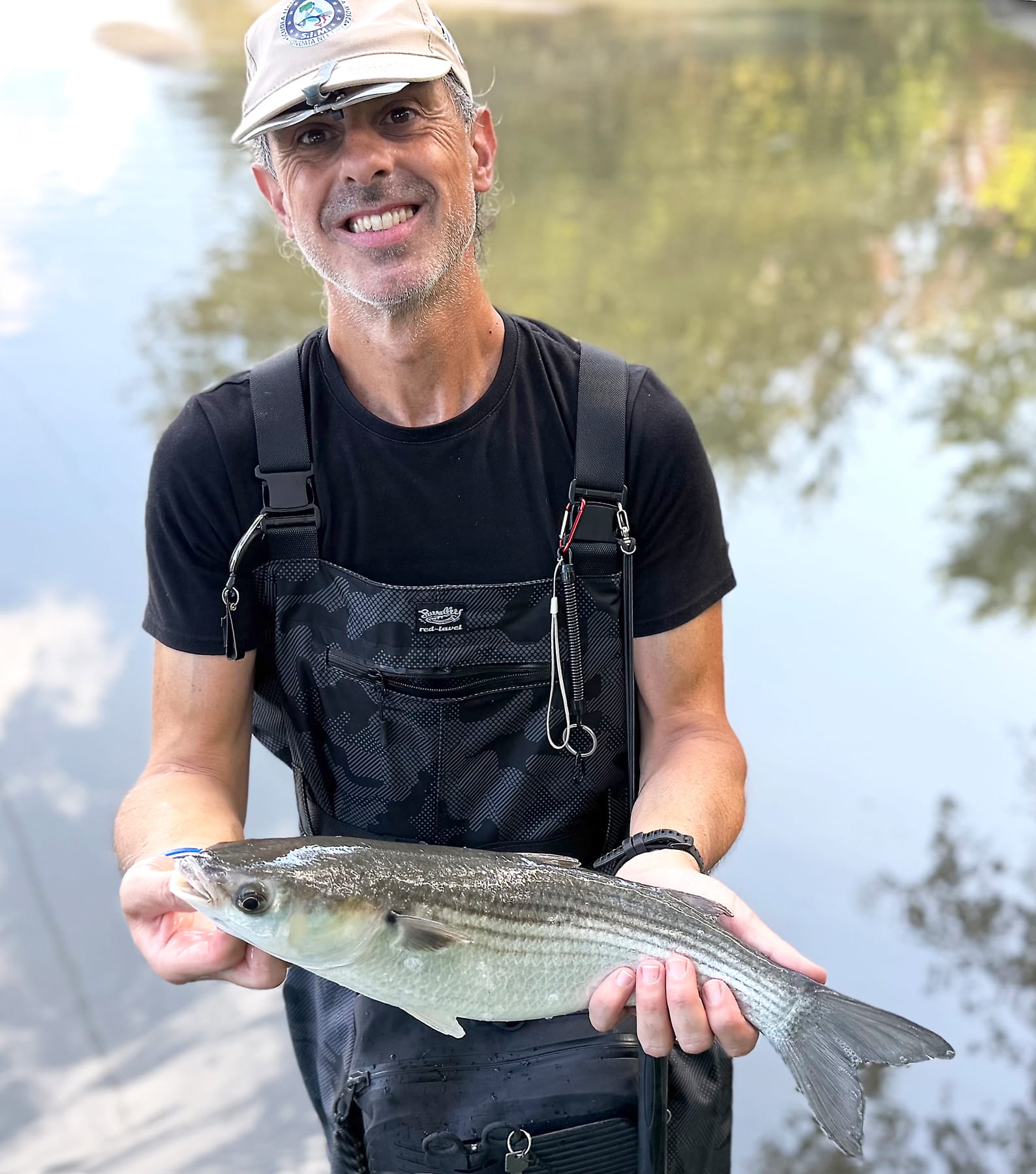
Mosca classica (by Marco Casu) - Oggi voglio invece provare a insidiare sia cavedani che cefali con la tecnica della mosca classica. Mi accordo con un caro amico di Roma, Flavio Gagliardi, che di buon mattino mi accompagna in una delle diverse anse del Tevere. Rispetto a Castel Giubileo le acque di questo sito più a valle, nel quartiere Portuense, sono placide e il contorno ambientale è molto naturale, con le rive ricche di vegetazione che si specchia sul grande fiume. Pesco con una canna 9 piedi con coda WF #7, un terminale conico di nylon da 0,20 in punta e un tippet in fluorocarbon del diametro dello 0,16, per una lunghezza totale di circa 300 centimetri, con una sola mosca. Iniziamo insidiando i cavedani, pesci sospettosi che in quel tratto di fiume rimangono a portata di coda solo nelle ore con il sole basso. L’ostacolo principale è rappresentato dagli immani banchi di cefali che devono essere superati dalla mosca alla ricerca dei cavedani. La sfida è quella di non spaventarli con una posa rumorosa, altrimenti creano un “fracasso” che intimorisce e allontana i cavedani. Consigliato da Flavio, mi affido a un terrestrial tipo Chernobyl ant montato su amo n. 8, il cui corpo in foam ne assicura una grande galleggiabilità. I cavedani - sia italici (Squalius squalius) che europei (Squalius cephalus), questi ultimi riconoscibili per la presenza di pinne ventrali e anali aranciate - non tardano ad abboccare, attirati dallo stripping veloce, facendo esplodere l’acqua sotto il terrestrial. Ne perdiamo diversi, ma gli attacchi al fulmicotone e l’amo barbless alle volte portano a questa controindicazione.
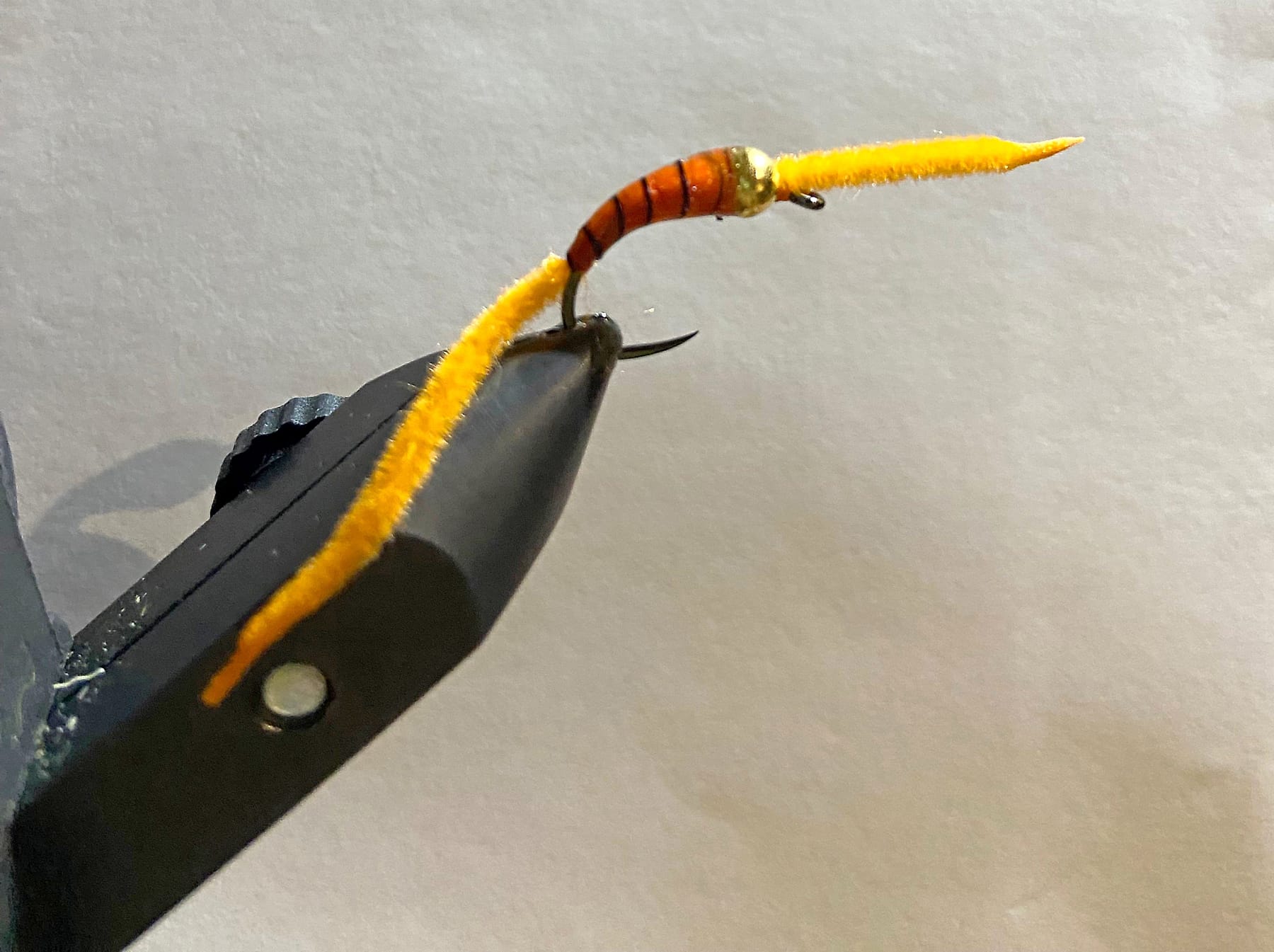
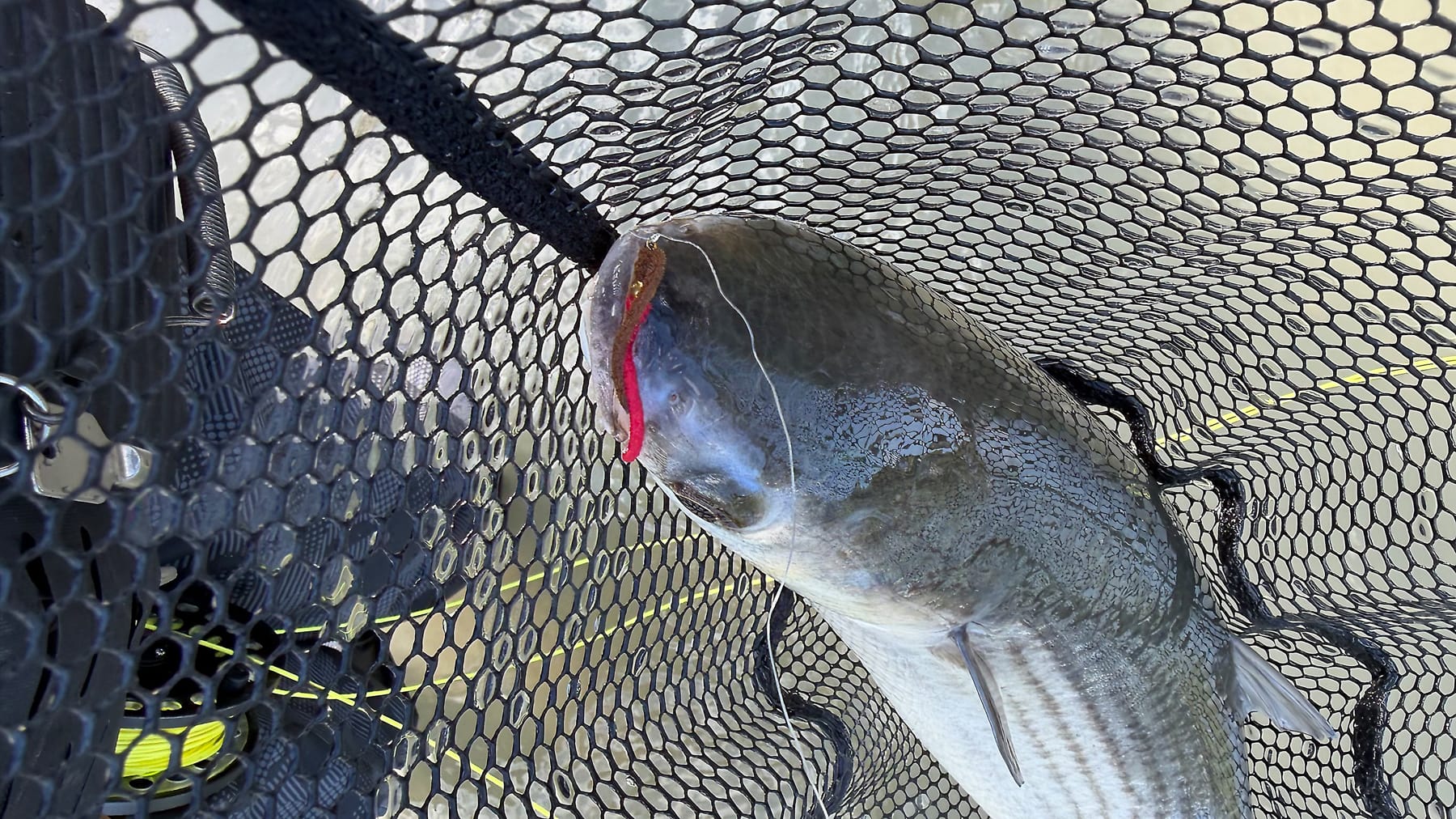
Una San Juan con la sinuosa ciniglia arancione che in acqua calamita i pesci che si nutrono in prossimità del fondo. il San Juan ancora fissato sulle delicate labbra del cefalo.
Con il sole più alto mi sposto al centro di una spiaggetta, vicino a un piccolo immissario, per cercare di catturare qualche bel cefalo. Un detto recita: “Pesce che si vede non si pesca!”, e in questo caso non si allontana molto dalla realtà. Infatti, le migliaia di pesci imbrancati sotto la superficie spesso non si degnano di attaccare il San Juan che gli piove sulla testa, e una coda posata male li disperde. Capisco allora che devo cambiare tecnica, uso la doppia trazione per superare il branco e lascio che la ninfa si poggi sul fondo, poi la muovo lentamente, esattamente sotto le tantissime bocche dei cefali che bollano in superficie. Qualcuno viene attratto dal movimento sinuoso della ciniglia del San Juan, che imita un vermetto sul fondo, e abbocca. E da quel momento inizia il delirio, quello creato da un grosso cefalo calamita indemoniato, che tira, salta e tira nuovamente, mai domo neanche quando vede la bocca del guadino. Ne porto a riva diversi, ma sono più quelli che perdo durante le fasi del combattimento… Il divertimento è anche questo, l’adrenalina che sale sinché non sei sicuro che il tuo bel cefalo è pronto per una foto, prima di essere restituito ai suoi compagni.
Fly-Tying (by Francesco Falessi)
San Juan perdigon: amo barbless n. 10–14 tipo Daikichi serie 191; bead di tungsteno color oro/rame misura mm 3,3–4; floss arancio; cm 5–6 di ciniglia arancio o rossa da mm 2; filo di rame bruno per anellatura.
Dressing - Si infila un’estremità nella bead collocando la pallina di tungsteno a due terzi della lunghezza della ciniglia (fiammata all’estremità). Viene inserito l’amo, poi fissato al morsetto. Si crea spessore di pochi giri subito dietro l’occhiello. Si colloca la bead in battuta sull’occhiello. Si costruisce la base del corpo con qualche giro di floss dietro la pallina, arrivando alla curvatura dell’amo. Qui si fissa l’estremità di 3–4 centimetri di filo di rame per l’anellatura del corpo. Si blocca la ciniglia all’amo creando una conicità del corpo e terminando i giri a ridosso della bead. Si gira il rame creando l’anellatura del corpo che sarà poi fissata con l’annodatore appena dietro la bead. Si termina il dressing con un passaggio di resina UV sul corpo anellato.
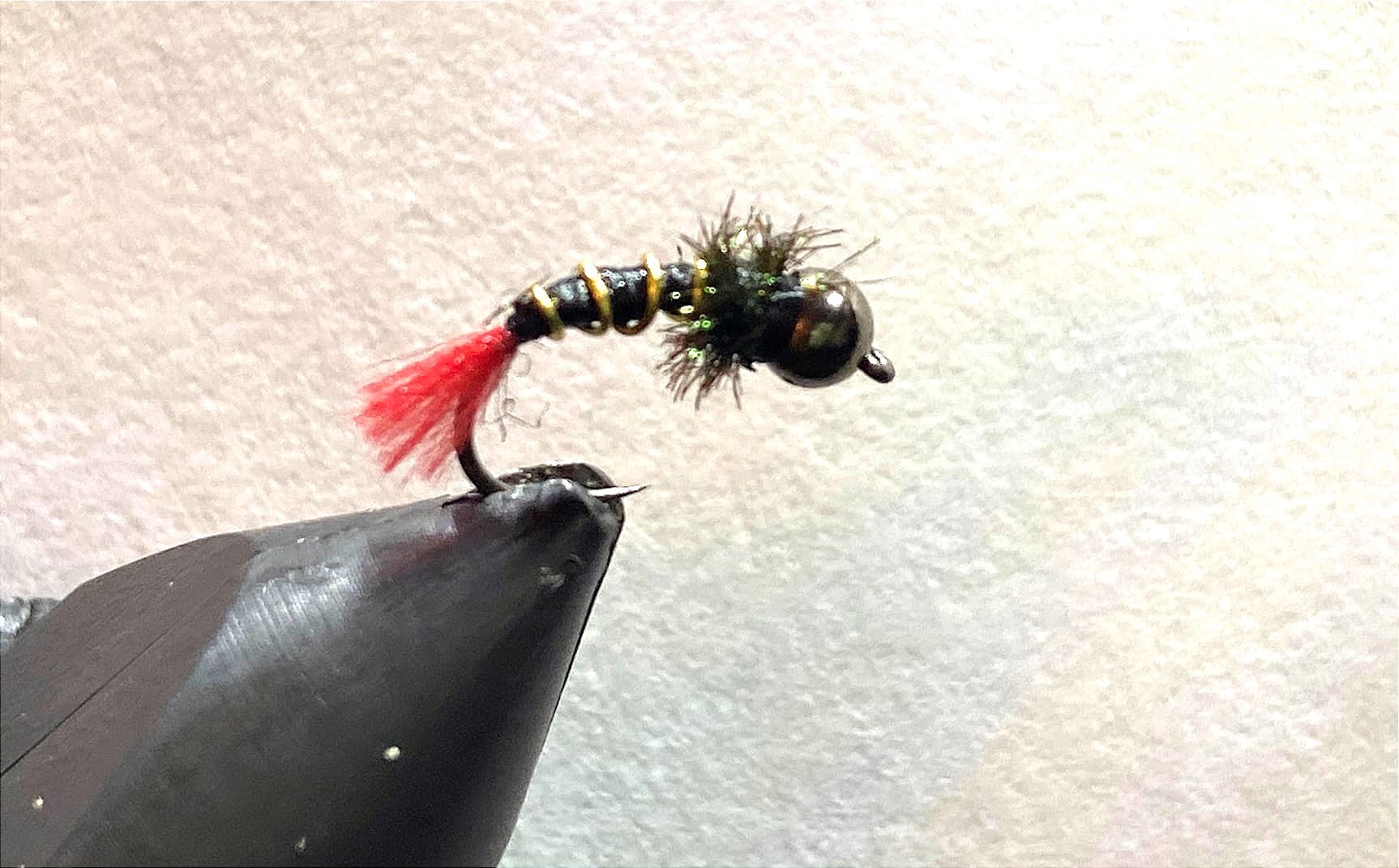
Ninfa di baetis: amo barbless n. 16 tipo Daikichi serie 191; bead misura mm 3 color brunito; floss nero; floss rosso raddoppiato per il tag posteriore: filo di rame dorato per anellatura; 2 calami di penna di pavone.
Dressing - Si infila la pallina sull’amo che viene poi bloccato sul morsetto. Si fissa il floss nero all’amo dietro la bead per tutta la lunghezza fino alla curvatura, dove si fissa in seguito il tag rosso di appena 3 millimetri. Successivamente si blocca il filo di rame e si procede a effettuare 3–4 giri, fissandolo 3–4 millimetri prima della pallina. Qui si monta il pavone che, con una pinza da hackles, viene avvolto con 3–4 spire ravvicinate e poi fissato. Si procede alla chiusura con l’annodatore subito dietro la bead. Una goccia di colla di chiusura garantisce la giusta resistenza.

MULLET BENEATH THE GREAT DOME
In this engaging report from the waters of the Tiber, the authors draw intriguing parallels between their target fish, mullet and chub, and their fishing methods, conventional fly fishing and Euro nymphing. Enjoy the read.
Mullet and chub: what connects these two fish? They belong to different families, Mugilidae and Cyprinidae respectively. The former are euryhaline, while the latter are strictly freshwater fish. Mullet often live in shoals, whereas chub, especially as adults, are solitary. Yet they share certain features: a silhouette typical of fish able to live in flowing water, a silvery colouration suggesting that they spend most of their time in the upper water layers and, finally, their Italian names, which refer to their large heads. “Cefalo” derives from the Greek kephalē, while “cavedano” comes from the Latin capito, both conveying the idea of a “large head”. On this occasion, we do not intend to delve into taxonomy, since there are several species of both mullet and chub. Instead, this article focuses on two fly-fishing techniques, Euro nymphing and conventional fly fishing, whose main difference lies in how the fly is presented in the water. Both are particularly effective for these two fish in Rome’s stretch of the Tiber.
Euro nymphing (by Francesco Falessi)
There is a place in Rome where the imposing appeal of industrial and urban heritage blends unexpectedly with flourishing nature. We are on the northern outskirts of the capital, specifically on the stretch of the Tiber immediately downstream of Castel Giubileo dam. It is an unconventional urban fishing spot that can offer any enthusiast tremendous enjoyment thanks to its astonishing diversity of fish. Here we find cyprinids including impressive carp, hard-fighting barbel, wily chub and voracious asp, as well as plenty of bream, roach and crucian carp. Large predators such as wels catfish and zander are also present. What makes this stretch truly unique, however, is the seasonal presence of marine fish. In late spring, shad move upstream, accompanied by huge numbers of mullet, mainly thinlip grey mullet (Chelon ramada), the most euryhaline member of the family, recognisable by a black spot at the “armpit” of its pectoral fins, and occasionally a sea bass. For our session, we chose the right bank, which slopes gently towards the middle of the channel thanks to sediment carried by the River Cremera. It joins the Tiber here, creating an ideal microhabitat for attracting fish. Looking across to the opposite bank, the view offers a distinctive sense of history: the great piers, stays and still-visible remains of the old railway bridge, bombed during the Second World War, stand as silent witnesses to our casts. Marco and I came to this stretch in search of powerful, untameable mullet. But we did not use the traditional Bolognese float rod or spinning tackle. Today, we are tackling Castel Giubileo with Euro nymphing. This technique uses micro fly lines or a straight monofilament system, keeping the line taut and almost entirely clear of the water, with no bows of line to interfere with the current.
Tackle
The tackle is light: a 10-foot rod paired with a DT #2 fly line. The nylon leader departs somewhat from standard Euro-nymphing practice: it is either tapered or built from three sections of progressively smaller diameter, and is as long as the rod. The tippet consists of 120 centimetres of 0.18–0.20 mm nylon. The rig uses two nymphs. The heavier fly goes on the point, while the second is tied to a dropper around 15 centimetres long, positioned 60–70 centimetres above the point nymph. For this session, we chose two home-tied patterns: an orange-toned San Juan nymph on the point and a dark Baetis nymph on the dropper. To make takes easier to detect, we use a small strike indicator or 30 centimetres of two-tone nylon inserted around 150 centimetres above the point nymph.
Technique
We fish in Euro-nymphing style: the rod constantly leads and guides the drift to keep the tip in perfect contact with the flies, something the river’s strong current often makes difficult. The arm must maintain steady tension, ready to strike at the slightest pause in the line before the cunning mullet can spit out the fly. The approach pays off from the first casts, and the takes are not long in coming. Large mullet bend the carbon of the 10-foot rod, making powerful runs before finally reaching the landing net.
Conventional fly fishing (by Marco Casu)
Today, I want to try targeting both chub and mullet with conventional fly-fishing tackle. I arrange to meet a close friend from Rome, Flavio Gagliardi, who takes me early in the morning to one of the Tiber’s many bends. Compared with Castel Giubileo, the water at this spot farther downstream, in the Portuense district, is placid, and the surroundings are very natural, with richly vegetated banks reflected in the broad river. I fish a 9-foot rod with a WF #7 line, a tapered nylon leader ending in 0.20 mm and a 0.16 mm fluorocarbon tippet, for an overall length of around 300 centimetres, using a single fly. We begin with chub, wary fish that remain within fly-casting range on this stretch only while the sun is low. The main obstacle is the enormous shoals of mullet that the fly must pass beyond to reach the chub. The challenge is not to frighten them with a noisy presentation, otherwise they create a commotion that alarms the chub and drives them away. On Flavio’s advice, I choose a Chernobyl Ant-style terrestrial on a size 8 hook, its foam body providing excellent buoyancy. The chub, both Italian chub (Squalius squalius) and European chub (Squalius cephalus), the latter recognisable by their orange pelvic and anal fins, soon take, attracted by fast stripping and exploding through the water beneath the terrestrial. We lose several, but explosive strikes and a barbless hook sometimes have that drawback. As the sun rises higher, I move to the middle of a small beach near a minor tributary, hoping to catch a few good mullet. There is a saying, “A fish you can see is a fish you cannot catch!”, and here it is not far from the truth. The thousands of fish shoaling just beneath the surface often do not deign to take the San Juan dropping onto their heads, and a badly presented fly line scatters them. I realise I need to change technique. I double-haul to cast beyond the shoal and let the nymph settle on the bottom, then move it slowly, directly beneath the countless mouths of mullet rising at the surface. Some are attracted by the sinuous movement of the San Juan’s chenille, imitating a little worm on the bottom, and take. From that moment, chaos begins: the chaos created by a large, frenzied thinlip grey mullet that pulls, jumps and pulls again, never beaten even when it sees the mouth of the landing net. I bring several ashore, but lose even more during the fight… That is part of the enjoyment too: the rising adrenaline until you are finally sure your fine mullet is ready for a photograph before being returned to its companions.
FLY-TYING (by Francesco Falessi)
San Juan perdigon: size 10–14 barbless hook, such as a Daikichi series 191; 3.3–4 mm gold/copper tungsten bead; orange floss; 5–6 centimetres of 2 mm orange or red chenille; brown copper wire for ribbing.
Tying sequence – Thread one end of the chenille through the bead, positioning the tungsten bead two-thirds of the way along the chenille, whose end has been singed. Insert the hook, then secure it in the vice. Build up a small base with a few turns immediately behind the eye. Push the bead up against the eye. Form the body base with a few turns of floss behind the bead, working back to the hook bend. Here, tie in the end of a 3–4-centimetre length of copper wire for ribbing the body. Secure the chenille to the hook, forming a tapered body and finishing the turns close behind the bead. Wind the copper wire to rib the body, then secure it and whip-finish just behind the bead. Complete the dressing with a coating of UV resin over the ribbed body.
Baetis nymph: size 16 barbless hook, such as a Daikichi series 191; 3 mm dark-finished bead; black floss; doubled red floss for the rear tag; gold-coloured copper wire for ribbing; two peacock quills.
Tying sequence – Slide the bead onto the hook, then secure the hook in the vice. Tie in the black floss behind the bead and wrap along the full shank to the bend, where a red tag just 3 millimetres long is then tied in. Next, secure the copper wire and make three or four turns, tying it off 3–4 millimetres short of the bead. Tie in the peacock here and use hackle pliers to wind three or four closely spaced turns, then secure it. Whip-finish immediately behind the bead. A drop of head cement provides the necessary durability.
Commenti ()