
Una predisposizione naturale e tanta passione, spingono il protagonista di questa mese a specializzarsi nella pesca all’aspetto, con risultati straordinari.
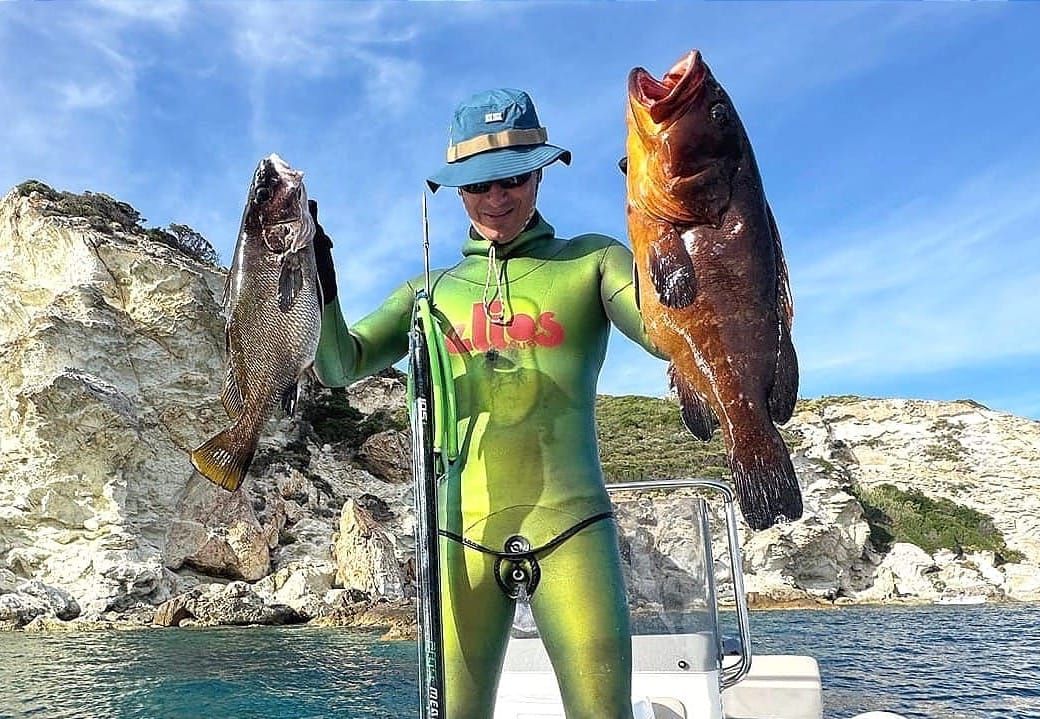
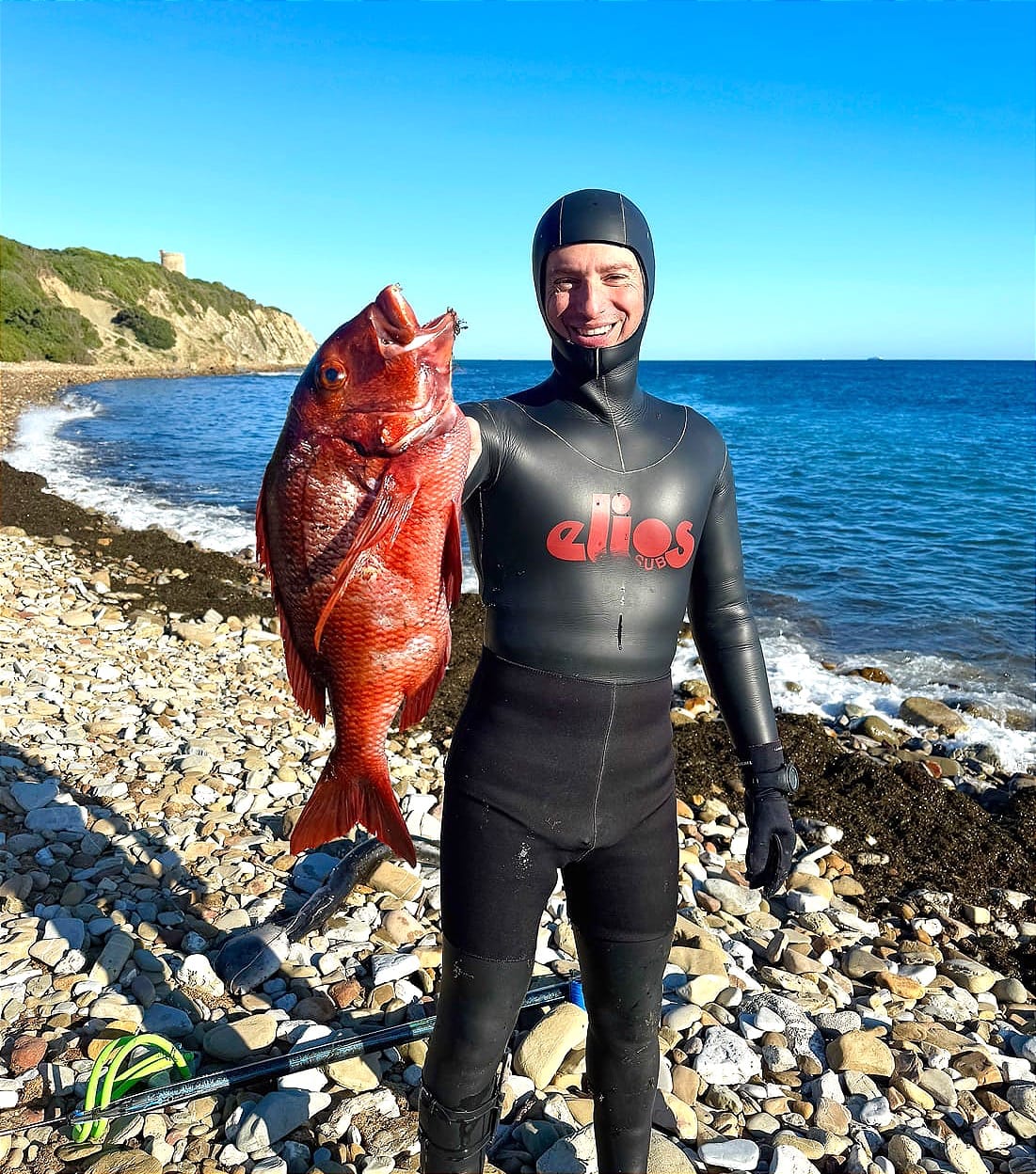
foto in alto: Fabrizio con due belle prede. L’appariscente muta integra una speciale pellicola coibentante che non interferisce sul comfort della 5 millimetri, ma produce la termicità tipica di una 7.
Fabrizio non aveva più di 5 anni, ma aveva un nonno che amava il mare e una nonna napoletana con casa a Ischia. Gli scogli di Sant’Anna erano lì, circondati da un’acqua cristallina, irresistibili. In questo scenario il giovanissimo e futuro subacqueo con tanto di maschera, boccaglio e retino, armato solo delle sue mani, raccoglieva quel che poteva, tutti i giorni delle sue lunghe vacanze campane. E in mezzo a queste, vista l’ormai acclarata acquaticità, Fabrizio, inconsciamente, si sottopone al benevolo test del grandad. “Vedi quella conchiglia di riccio sul fondo? Raccoglila!”. Fu così che a soli 5 anni Fabrizio s’immerse per ben 5 metri, risalendo con l’importante trofeo.
Poi cosa successe? Niente. Col mio corpetto Elios continuai per molte altre estati a godermi il mare di Ischia e raccogliere cannolicchi e vongole in Adriatico. Passai alla fiocina, e finalmente a 16 anni, spalleggiato da un amico marchigiano, Guido Guidelli, mi armai prima con un fucile, un Beuchat 75, poi con un piccolo natante in vetroresina messo in acqua tra le rocce e i frangiflutti, sotto il colle di San Bartolo, a Pesaro. E qui, coi primi muggini, capì che avevo il destino segnato.
Quindi arrivò una preda importante? Diciamo che la prima preda significativa, più importante dei soliti pescetti, arrivò abbastanza presto, a 17 anni. Facevo un aspetto sempre a San Bartolo, sul cappello dei frangiflutti. Una nuvoletta di muggini si avvicinava ignara, ma io aspettai che mi sfilassero davanti perché al club (Asd Sub Tridente Pesaro), qualcuno mi disse di stare attento perché probabilmente subito dietro quei pesci poteva esserci una spigola. E così fu. Passati i cefali aspettai la spigola e la fulminai. Ero felicissimo! Mi precipitai al circolo per condividere l’esperienza, telefonai a Annalena, la mia fidanzata e attuale moglie e infine a mia mamma che la cucinò.
Dopo questa spigola? Dopo questa spigola Ettore Trebbi, al quale facevo da barcaiolo, mi convinse a fare le gare, le selettive. Partecipai due volte, a Ancona e a Civitanova, purtroppo con scarsi risultati. Ebbi maggiori soddisfazioni pescando, fuori Ancona, orate e saraghi e grosse ricciole.
Un aneddoto? Beh, forse non ancora ventenne, a pesca con Ettore, feci una grande scoperta, anzi la fece proprio Ettore. Valutando le mie capacità di apneista, mi chiese di strappare un ciuffo di posidonia a 20 metri. Non me lo feci ripetere e al ritorno mi chiese: “Ma tu non compensi?”. Scoprì che avevo una compensazione spontanea (hands free). Poi conobbi Filippo Sparacca col quale strinsi un’amicizia che ci portò a pesca, insieme, in Sardegna, a Stintino, nel 2001. Il nonno della compagna viveva lì, in via Tonnara. Si usciva al mattino presto e si stava in acqua fino al tramonto, soprattutto nel Mare di fuori, tra Scoglietti e i Porri. La prima volta pescai entro i primi 15 metri diversi saraghi e corvine e una cernia di 3 chili.
Un altro aneddoto? Tempo fa contattai la Seatec perché per la maturità mi regalarono un fucile ma il mulinello non andava bene. Mi rispose Valerio Grassi il progettista e gli proposi una modifica. Andai a trovarlo in azienda, diventai suo amico e rimediai una sponsorizzazione.
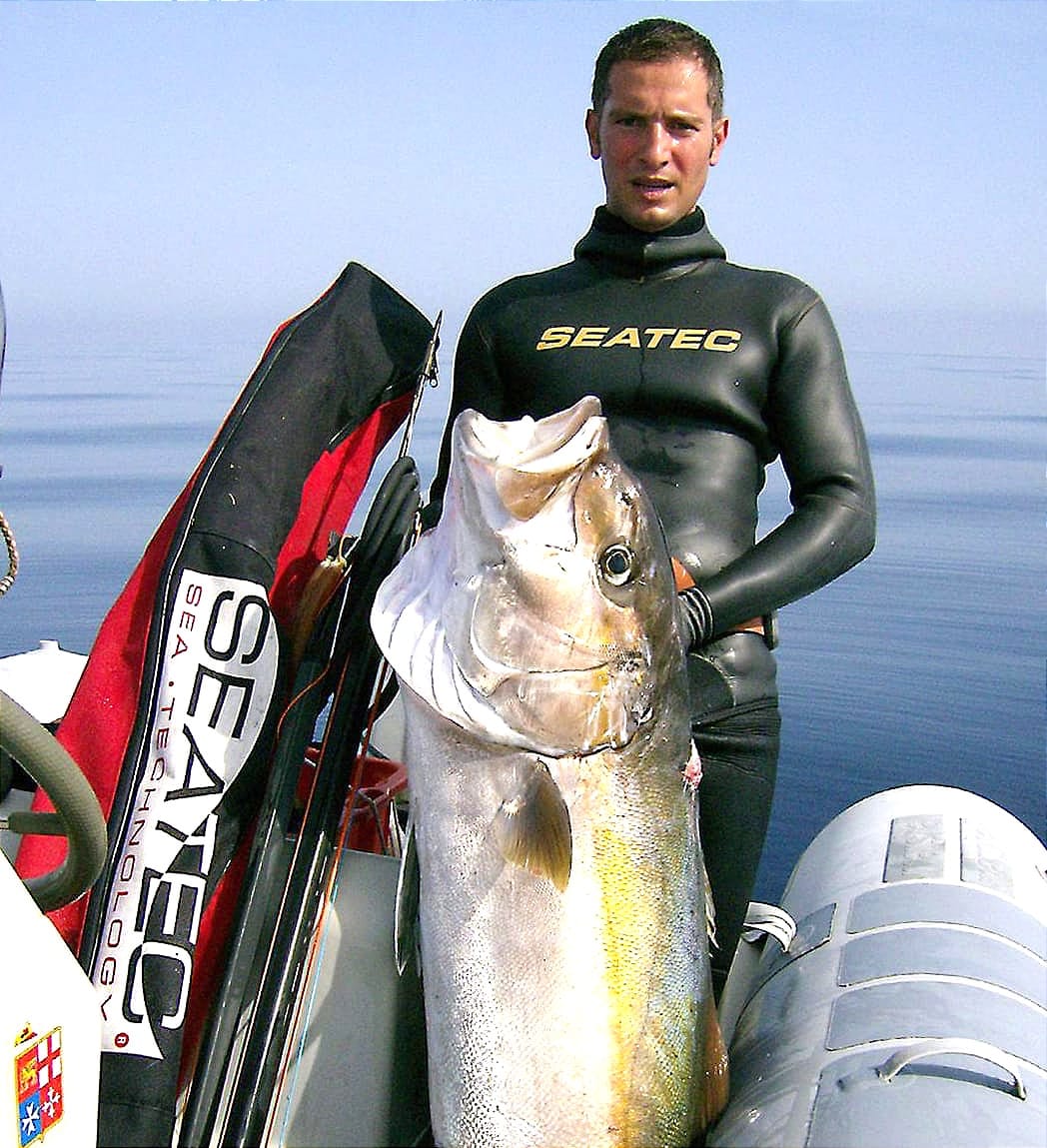
La preda più grossa? A vent’anni ho iniziato a pescare grosse ricciole, ma è nell’agosto del 2004 che ho stabilito il record. Ero a Pesaro con un amico. Uscimmo presto in gommone e ci dirigemmo a est. Era una bella giornata, soleggiata e senza vento. Il mare era calmissimo e la visibilità eccezionale, più o meno 25 metri. M’immersi in un fondale di 31 metri e a metà strada intravidi una ricciola alla mia destra che nuotava e mi veniva incontro. Capì che poteva sfilarmi davanti troppo presto. Mi lasciai cadere accompagnando la corsa nella speranza di non fare rumore. A una distanza di tre metri e mezzo ce l’avevo proprio sotto di me. Sparai sopra la testa fulminandola, o quasi. Risalii, la richiamai col mulinello, feci qualche fotosub, purtroppo di pessima qualità, ma il giorno dopo organizzai una cena con una decina di amici col certificato di “buona forchetta”. Di quelle bistecche non rimase nulla.
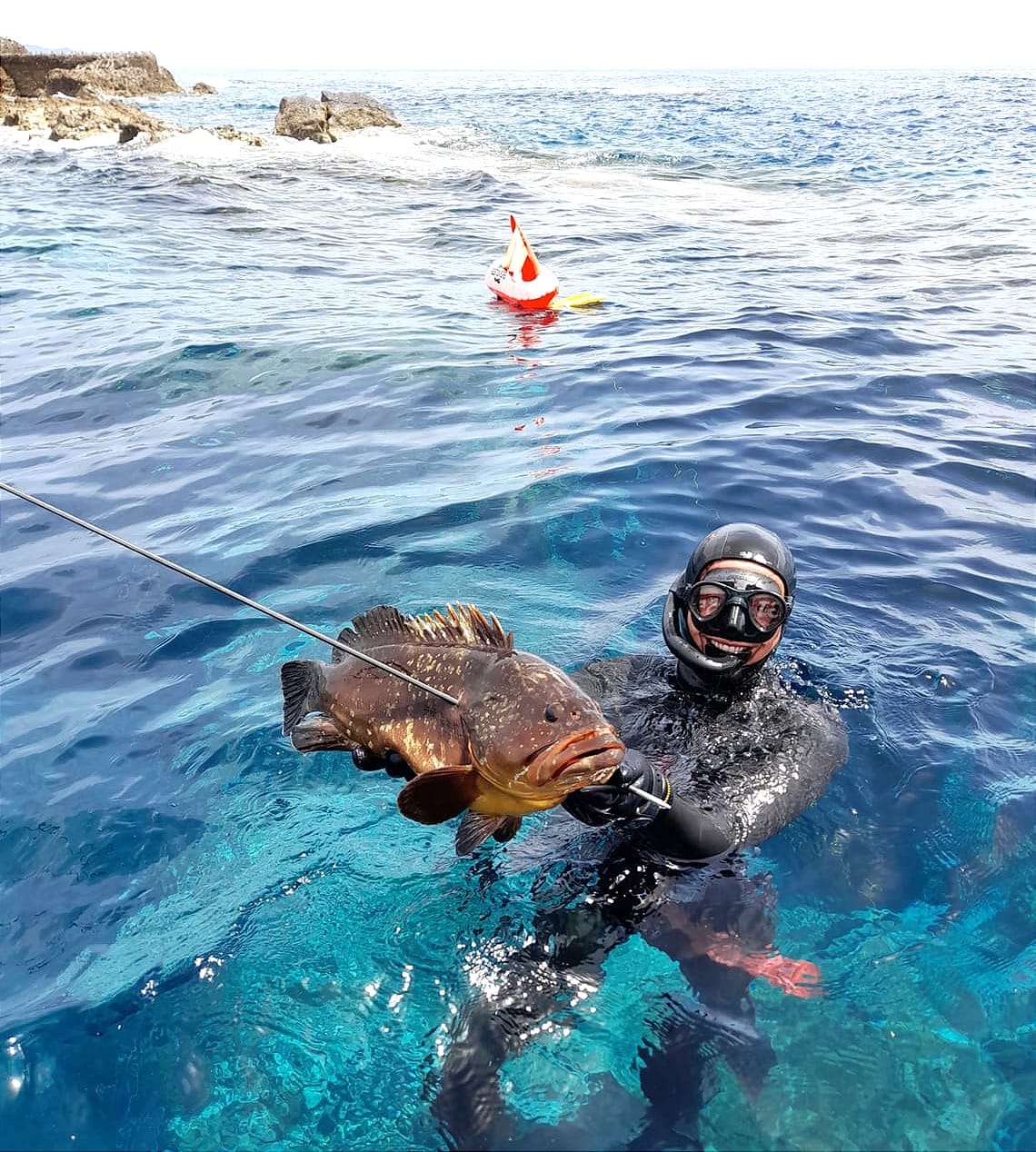
Un pesce difficile? A Ponza, un posto meraviglioso, una bomboniera con acqua limpidissima ma pesci difficili, è il mio paradiso preferito ma non è per tutti. Planando in ispezione sul fondo, tra Ponza e Zannone, vidi una cernia in candela. Risalìì sulla verticale e pedagnai. M’immersi dopo una buona ventilata e di nuovo giù. La vidi ma quasi a tiro, si rifugiò in tana a 33 metri. Ripetei il tentativo ma lei al momento giusto filò via di nuovo in tana. E così per ben 5 volte. Dovetti ragionarci sopra e tornare il giorno successivo col barcaiolo. E per altre due volte la stessa scena. Capìì che la cernia mi prendeva il tempo. Quindi mi feci trascinare con la fune dal barcaiolo controcorrente rompendo il tempo alla cernia. Sparai in caduta sulla testa mentre usciva dalla tana. Grande soddisfazione ma anche un pizzico di dispiacere.
Viaggi all’estero? Certo, l’ultimo è del gennaio del 2025 in Andalusia, nell’Oceano atlantico, tra Capo Trafalgar e Tarifa. Posti belli ma ancor di più impegnativi. Ero in compagnia di Alberto Martignani, bravissimo pescasub, che mi ha messo subito in allarme: attento alla corrente e infila sotto la cintura, nella schiena, un paio di ciabatte. Un po’ perplesso, ma ubbidiente seguo il consiglio. La ragione, non svelata inizialmente, è che la corrente è così forte, specialmente ai cambi di marea, che ti trasporta dove vuole e una volta atterrato, per rientrare e raggiungere l’automobile, devi fare anche qualche chilometro, naturalmente a piedi.
Un'avventura? Lo scorso anno con Giacomo Palazzi, mio attuale compagno di pesca. Eravamo a 40 miglia dalla costa davanti a Pesaro. Cercavamo le mangianze dei tonni. Giacomo al timone e io sul tubolare pronto a tuffarmi alla fine della corsa verso la mangianza. Una volta in acqua i tonni si avvicinano e ti nuotano intorno in cerchi sempre più stretti. Tu sei in caduta e spari solo quando riconosci e vedi l’occhio grosso come quello dell’esemplare adulto. Segue il recupero, divertente perché inizialmente vieni trainato da un treno in fuga, e in questo caso Giacomo ti segue appresso col gommone. Quello stesso giorno, oltre l’indimenticabile esperienza col tonno di 60 chili, assistemmo a un carosello a opera di un banchetto di mante che nuotavano intorno al gommone e poi incontrammo anche un grosso pesce luna.
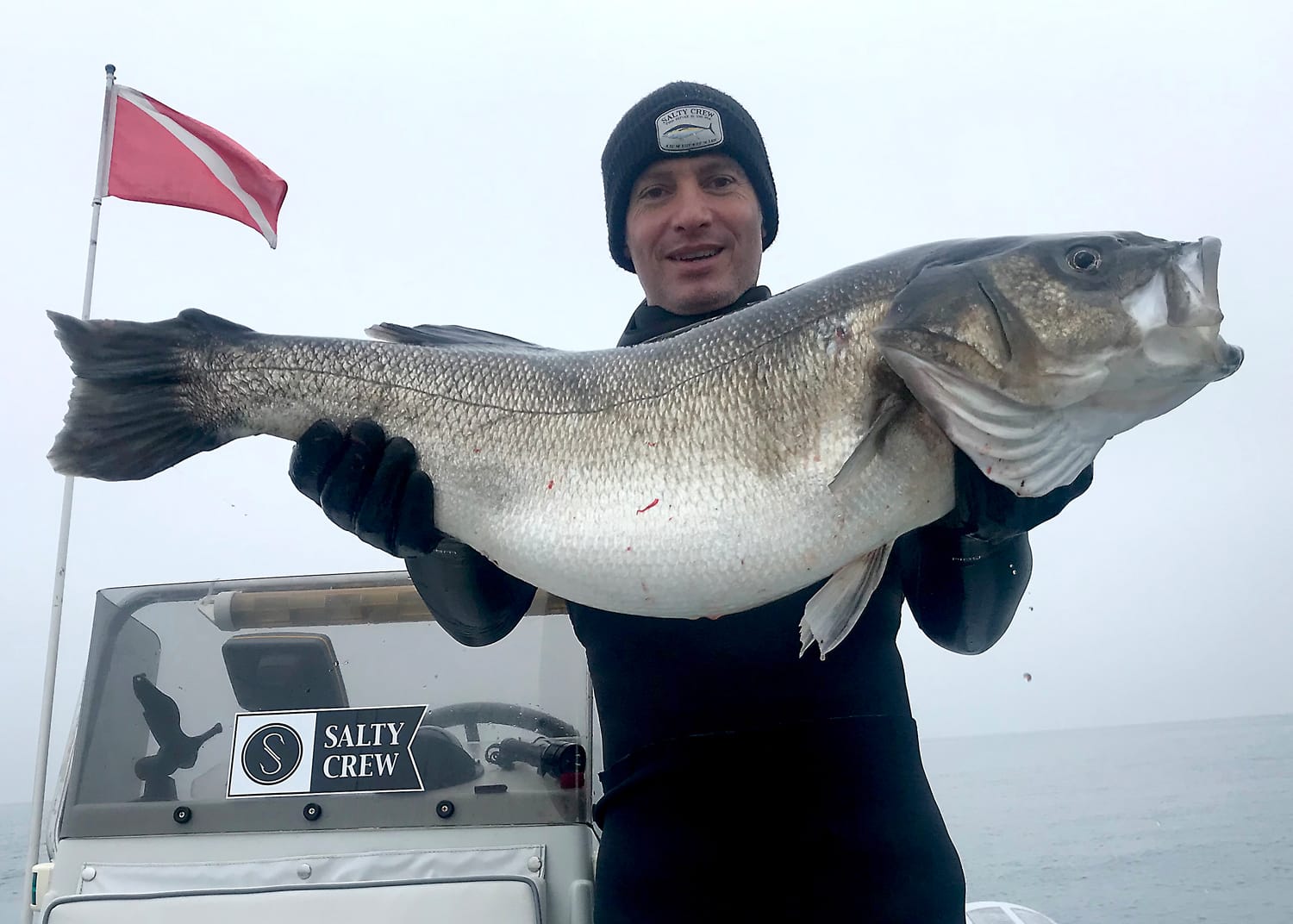
Qual è la tua tecnica preferita? Diciamo che sono fatto per l’aspetto, che le mie qualità trovano spazio in questa tecnica. Infatti dalle mie parti pratico con assiduità l’aspetto alla spigole. Nel novembre scorso ne ho sparato una di 9,8 chili e qualche anno fa una di poco più piccola: 9,5 chili.
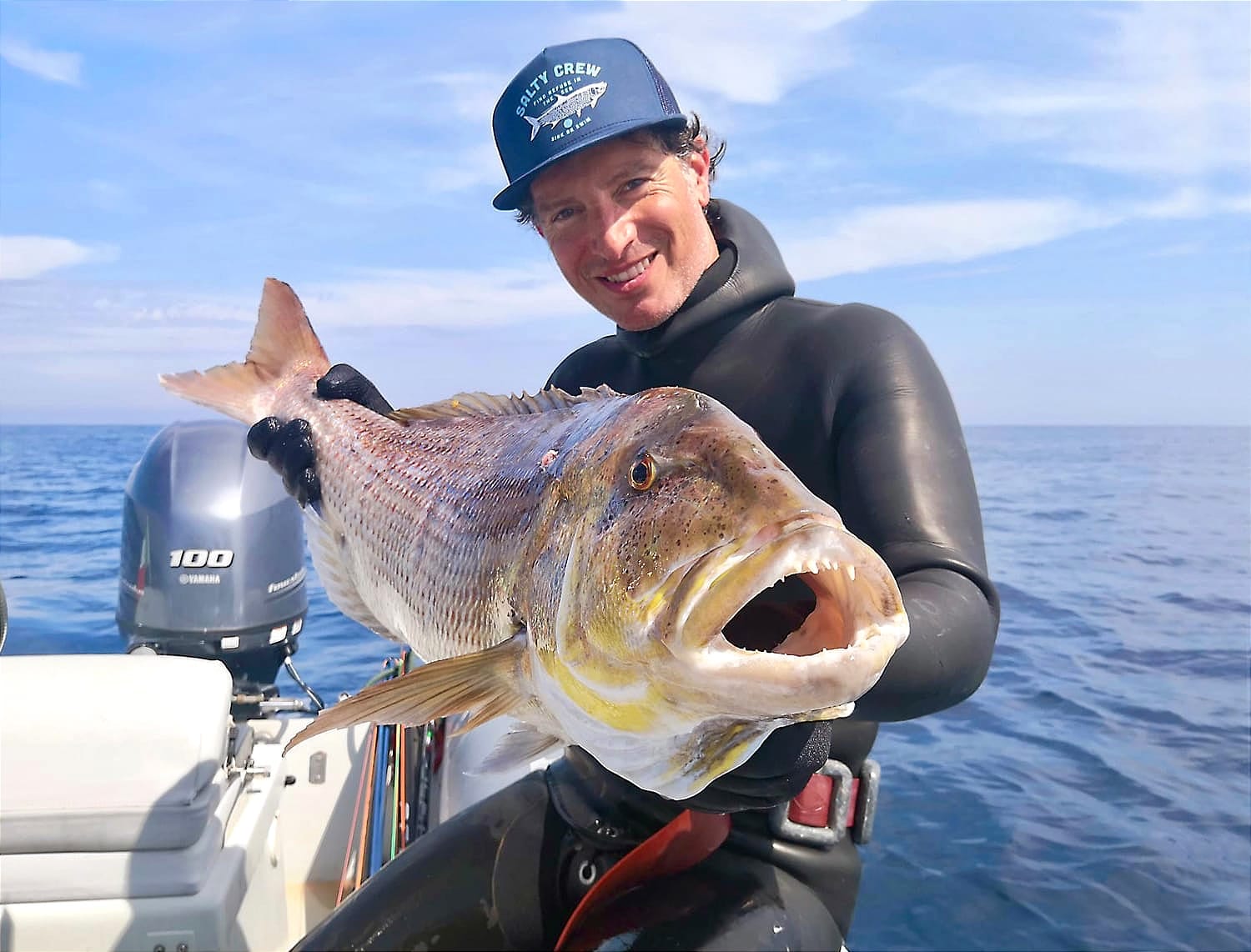
E questa muta verde-oro? Innanzitutto non ho mai creduto nel mimetismo. Ho sempre vestito il nero e questi colori nuovi e sgargianti stanno a significare che sono convinto proprio del contrario. I dentici si avvicinano senza freni, quasi spavaldi e lo stesso succede con le cernie all’agguato o in caduta.
Un consiglio per i neofiti? Da giovane m’incuriosiva capire come quelli bravi trovassero il pesce. Oggi (forse un po’ prima) ho capito che a parità di condizioni (profondità, temperatura e corrente) la storia si ripete. Comunque, andate in mare spesso, non abbiate fretta di bruciare le tappe e iscrivetevi a un club.
Sei pronto per Mazara? Sì, visto che nel 2011 ho ripreso a fare agonismo. Avevo maturato abbastanza esperienza e mi sentivo pronto, anche se non sfuggii alla gavetta. Le selettive andarono bene e nel 2013 mi ritrovai a San Foca in seconda categoria. Ma non andò come sperato. E tra selettive e altre prove in seconda, ma anche tre campionati regionali consecutivi vinti, quest’anno, a fine giugno, disputerò finalmente l’assoluto con Antonino Castiglione, mio validissimo assistente. Incrociamo le dita!
English version
Fabrizio was no more than five years old, but he had a grandfather who loved the sea and a Neapolitan grandmother with a home on Ischia. The rocks of Sant’Anna were right there—surrounded by crystal-clear water and simply irresistible. In this setting, the budding young diver—equipped with a mask, snorkel, and net, but otherwise armed only with his bare hands—would gather whatever he could throughout his long summer holidays in Campania. Amidst this, and given his evident comfort in the water, Fabrizio unknowingly faced a friendly test from his grandfather: "See that sea urchin shell on the bottom? Go get it!" And so, at just five years old, Fabrizio dove down a full five meters, surfacing with his prized trophy.
What happened next? Nothing much. I continued to enjoy the waters of Ischia and harvest razor clams and regular clams in the Adriatic for many more summers wearing my Elios vest. I moved on to using a spear, and finally, at sixteen—encouraged by a friend from the Marche region, Guido Guidelli—I armed myself first with a speargun (a Beuchat 75) and then with a small fiberglass boat, which I launched from the rocky shore near the breakwaters beneath the San Bartolo hill in Pesaro. It was there, as I landed my first few mullet, that I realized my destiny was sealed.
So, did you land a significant catch? Let’s say the first meaningful catch—something more important than the usual small fry—came quite early, when I was seventeen. I was doing an ambush hunt, again at San Bartolo, right on the crest of the breakwater. A small school of mullet was approaching, oblivious, but I waited for them to swim past me; someone at the club (ASD Sub Tridente Pesaro) had told me to be careful, as a sea bass might well be lurking right behind them. And that’s exactly what happened. Once the mullet had passed, I waited for the sea bass and took it out instantly. I was overjoyed! I rushed to the club to share the experience, called Annalena—my girlfriend and now my wife—and finally my mom, who cooked it for me.
What happened after that sea bass? After that catch, Ettore Trebbi—for whom I acted as a boatman—convinced me to enter competitions, specifically the qualifying rounds. I took part twice, in Ancona and Civitanova, though unfortunately with poor results. I found greater satisfaction fishing for gilt-head bream, white seabream, and large amberjacks off the coast of Ancona.
An anecdote? Well, back when I was still under twenty and fishing with Ettore, I made a major discovery—or rather, Ettore did. Assessing my freediving abilities, he asked me to pull up a clump of *Posidonia* seaweed from a depth of twenty meters. I didn't need to be told twice, and upon my return, he asked, "Wait, don't you equalize?" He discovered that I had a spontaneous (hands-free) equalization technique. Later, I met Filippo Sparacca; we struck up a friendship that led to us fishing together in Sardinia—specifically in Stintino—in 2001. His partner’s grandfather lived there, on Via Tonnara. We would head out early in the morning and stay in the water until sunset, mostly in the open sea area between Scoglietti and I Porri. The first time, I caught several annular seabream and brown meagre, as well as a 3-kilogram grouper, within the first 15 meters.
Another anecdote? Some time ago, I contacted Seatec because I’d been given a speargun as a graduation gift, but the reel wasn't working right. Valerio Grassi, the designer, replied to me, and I suggested a modification. I went to visit him at the company, became friends with him, and even landed a sponsorship.
My biggest catch? I started hunting large amberjacks when I was twenty, but I set my record in August 2004. I was in Pesaro with a friend. We headed out early in a RIB and steered east. It was a beautiful day—sunny and windless. The sea was dead calm, and visibility was exceptional—around 25 meters. I dove down to a depth of 31 meters; halfway down, I spotted an amberjack to my right, swimming toward me. I realized it might pass by too quickly. I let myself sink, carefully controlling my descent to avoid making any noise. When it was three and a half meters away, it was right beneath me. I shot it just above the head, killing it instantly—or almost. I surfaced, hauled it in using the reel, and took a few underwater photos—unfortunately of poor quality—but the next day I organized a dinner for about ten friends who were serious foodies. Not a scrap of those steaks was left.
A challenging fish? Ponza—a wonderful place, a gem with crystal-clear water but tricky fish—is my favorite paradise, though it’s not for everyone. While gliding over the seabed on a scouting dive between Ponza and Zannone, I spotted a grouper hovering vertically. I surfaced directly above the spot and dropped a marker buoy. After a good breathing session, I dove back down. I saw it—almost within range—but it darted into its hole at a depth of 33 meters. I tried again, but at the crucial moment, it slipped back into its den. This happened five times in a row. I had to rethink my strategy and return the next day with the boatman. The same scene played out twice more. I realized the grouper was anticipating my timing. So, I had the boatman tow me against the current on a line, disrupting the fish's rhythm. I fired while descending, aiming for its head as it emerged from the hole. It was a moment of great satisfaction, yet tinged with a hint of regret.
Trips abroad? Certainly; my most recent one was in January 2025 to Andalusia, on the Atlantic coast between Cape Trafalgar and Tarifa. These are beautiful locations, but extremely demanding. I was with Alberto Martignani, a highly skilled spearfisherman, who immediately warned me: "Watch out for the current, and tuck a pair of flip-flops under your weight belt against your back." A bit puzzled but compliant, I followed his advice. The reason—not revealed at first—was that the current is so strong, especially during tide changes, that it sweeps you wherever it pleases; once you land, getting back to the car requires a trek of several kilometers—on foot, of course.
An adventure? That happened last year with Giacomo Palazzi, my current fishing partner. We were 40 miles off the coast near Pesaro, looking for tuna feeding frenzies. Giacomo was at the helm, and I was perched on the inflatable’s pontoon, ready to dive in at the end of the dash toward the action. Once you’re in the water, the tuna approach and swim around you in ever-tightening circles. You descend and only take the shot when you spot an eye the size of an adult specimen's. Then comes the retrieval—an exciting process, since you’re initially being towed by what feels like a runaway train, while Giacomo follows close behind in the boat. That same day, in addition to the unforgettable experience with a 60-kilogram tuna, we witnessed a swirling display by a small group of manta rays circling our boat, and we even encountered a large sunfish.
What is your favorite technique? Let’s just say I’m built for the *aspetto* (ambush/waiting) technique; my strengths really shine there. In fact, back home, I regularly hunt sea bass using this method. Last November, I speared one weighing 9.8 kilos, and a few years ago, another just slightly smaller—9.5 kilos.
And what about this green-and-gold wetsuit? First of all, I never used to believe in camouflage patterns. I always wore black, but these new, flashy colors show that I’m now convinced of the exact opposite. Dentex approach without hesitation—almost boldly—and the same happens with groupers when I’m hunting via *agguato* (stalking) or on the descent.
Any advice for beginners? When I was young, I was curious about how the experts managed to find fish. Today—or perhaps a little while ago—I realized that under similar conditions (depth, temperature, and current), the same patterns repeat themselves. In any case, get out to sea often, don’t rush the process, and join a club.
Are you ready for Mazara? Yes, especially since I returned to competitive spearfishing in 2011. I had gained enough experience and felt ready, though I still had to pay my dues. The qualifying rounds went well, and in 2013, I found myself competing in the Second Category at San Foca. Things didn’t go quite as hoped, though. But after a mix of qualifiers and other Second Category events—plus winning three consecutive regional championships—I’ll finally be competing in the National Championship this year, at the end of June, alongside Antonino Castiglione, my excellent assistant. Fingers crossed!

Commenti ()