
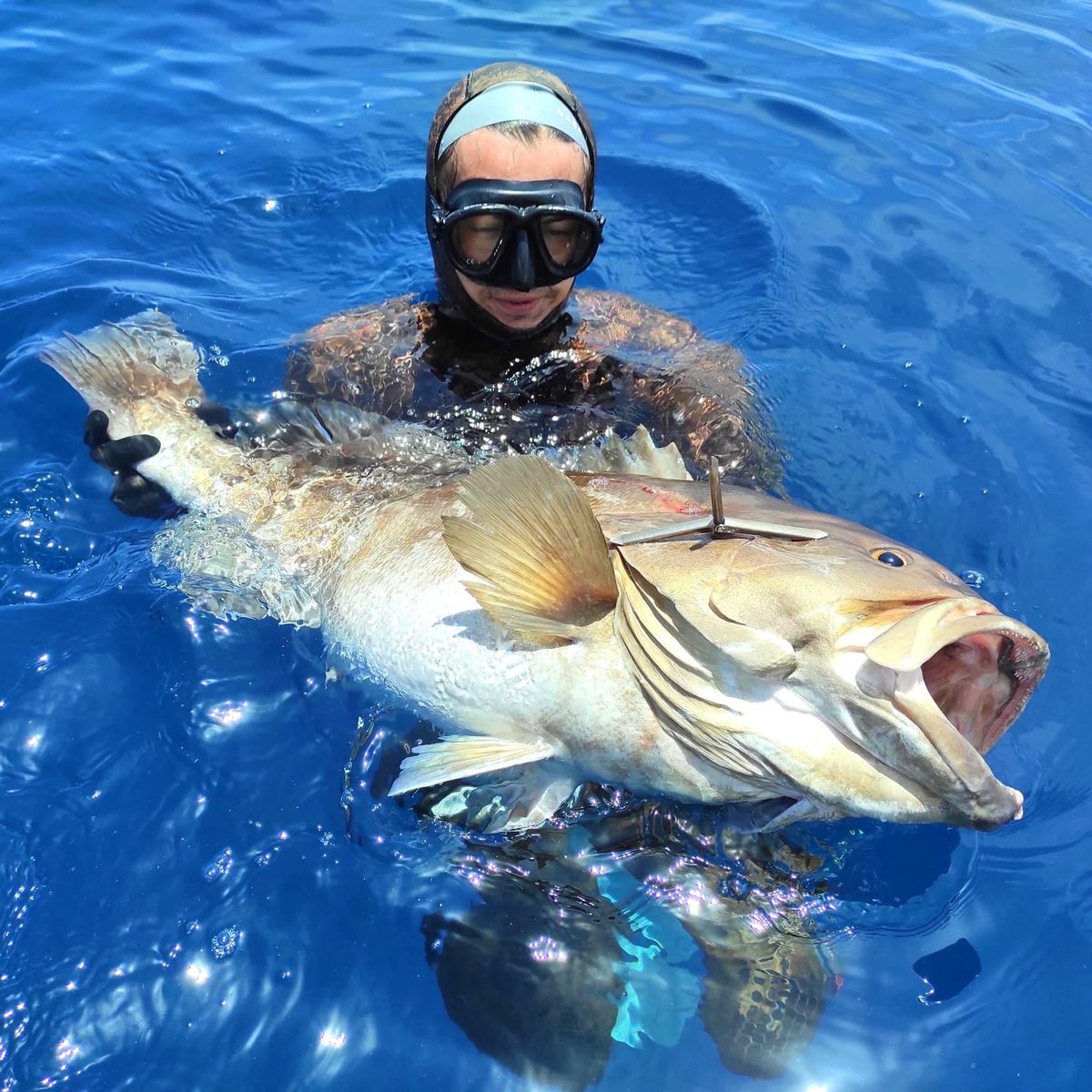
L’acqua è come l’aria, indispensabile, sia col fucile sia senza. Giacomo descrive le sue passioni, entrambe subacquee, che lo tengono sempre nel blu, del mare o della piscina.
Foto in alto: Giacomo sostiene una bella cernia bianca di quasi 16 chili catturata in una tana a -42 metri.
Le discese in fondo al mare sono iniziate col primo vagito, a Trapani. Giacomo Sergi, classe 1996, apriva gli occhi e vedeva il blu, dall’alto. Da sempre residente nella città di sale, vento e corallo col Tirreno da una parte e il Canale di Sicilia dall’altra, appena dodicenne e al seguito del fratello maggiore, matura le prime esperienze subacquee, finché a 16 anni comincia a utilizzare, in condivisione col fratello, l’Omer HF 75 di famiglia. Di lì a poco però, lo stretto parente per ragioni professionali, si allontana dalla pescasub. E così Giacomo scopre nuove amicizie dalle quali, tra Trapani e San Vito lo Capo, apprende tecniche e conoscenze.
Poi cosa successe? D’importante direi il corso di apnea con Francesco Nicotra del circuito Apnea Academy. Avevo appena compiuto 18 anni e nonostante fossi motivato dalla pescasub, con grande stupore mi resi conto che la pura apnea era affascinante. Migliorai le tecniche di respirazione e rilassamento, consolidando la mia predisposizione ad andar sotto con disinvoltura. Ma continuai a pescare con gli amici pur senza affiliarmi a un club. Poi, mi iscrissi in ingegneria a Torino. Studiavo e davo esami. L’obiettivo era svincolarmi dallo studio per vivere i tre mesi estivi al sud e godermi il mare e la pesca. A vent’anni acquisii il gommone di mio zio, lo attrezzai per la pesca e smisi di uscire da terra. Frequentavo alcune secche tra 8 e 12 metri, per saraghi e cerniotte. L’anno successivo frequentai un corso di pesca in apnea con Fabio Amico e nel 2021 partecipai a una selettiva. Non andai male, ma la scintilla non scoccò. E nel mentre, avrò avuto 24-25 anni, in apnea pura toccai i -40.
Un altro step? Mah, crescevo con regolarità, finché scoprii la pesca a sgancio. È stato come inserire il turbo. Provai sul mio corpo un’energia quasi inesauribile che mi gasò assai.
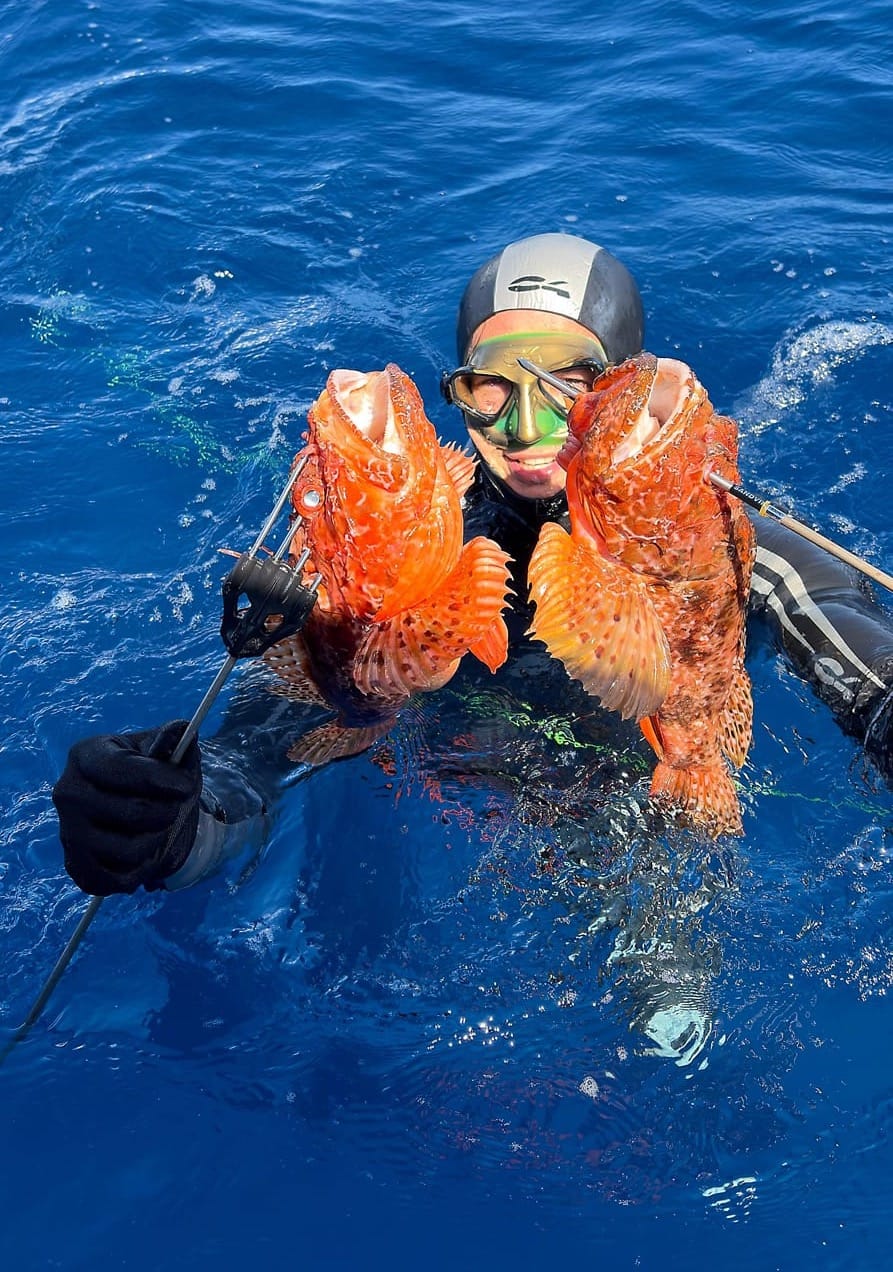
Il tuo primo pesce importante? Non ricordo se prima o dopo il primo corso, ma avevo 18 anni. Era estate, a Marausa dove ho casa al mare. Il posto non è pescoso ma la giornata era bella con mare piatto e acqua limpida. Uscii da terra e in un aspetto abbastanza noioso a 9-10 metri, con solo sporadici passaggi di saraghetti, da un masso sulla mia destra spuntò un sarago maggiore che mi veniva incontro dritto per dritto. Sparai in un cambio di direzione ma a distanza ravvicinata e lo beccai di fianco, subito dietro la testa. Riemersi a velocità supersonica per sfogare la mia felicità, era un bel pesce che pesò 820 grammi.
La preda più grossa? Era il 2020, avevo 24 anni e pescavo su un fondale sconosciuto con posidonia e poche rocce. Feci qualche planata mentre il barcaiolo mi seguiva e vidi un pesce intanarsi a 25 metri: una cernia di 8-10 chili. C’era corrente in superficie. Ero molto stanco e per la prima volta alle prese con un pesce così grosso. Un po’ imbarazzato e forse insicuro sul da farsi, decisi comunque di abbandonare il campo. Era troppo impegnativo per me, in quel momento. Tornai nello stesso posto dopo qualche giorno. Ritrovai i segnali alla prima discesa, grazie anche a una via di sabbia che conduceva esattamente all’apertura sotto la posidonia. Durante l’immersione vidi la cernia fuori dalla tana che senza perdere tempo s’infilò nella grotta. Avevo un Calibro 12, un oleopneumatico di cm 120 con arpione. Mi affacciai nella tana, illuminai la grotta oscura e lei era lì, di ¾. Lo sparo però non fu risolutivo. La misi in trazione e la portai su dopo 7-8 tuffi. Ero molto felice e stanchissimo. Ma soprattutto non credevo che fosse così grossa: 19 chili.
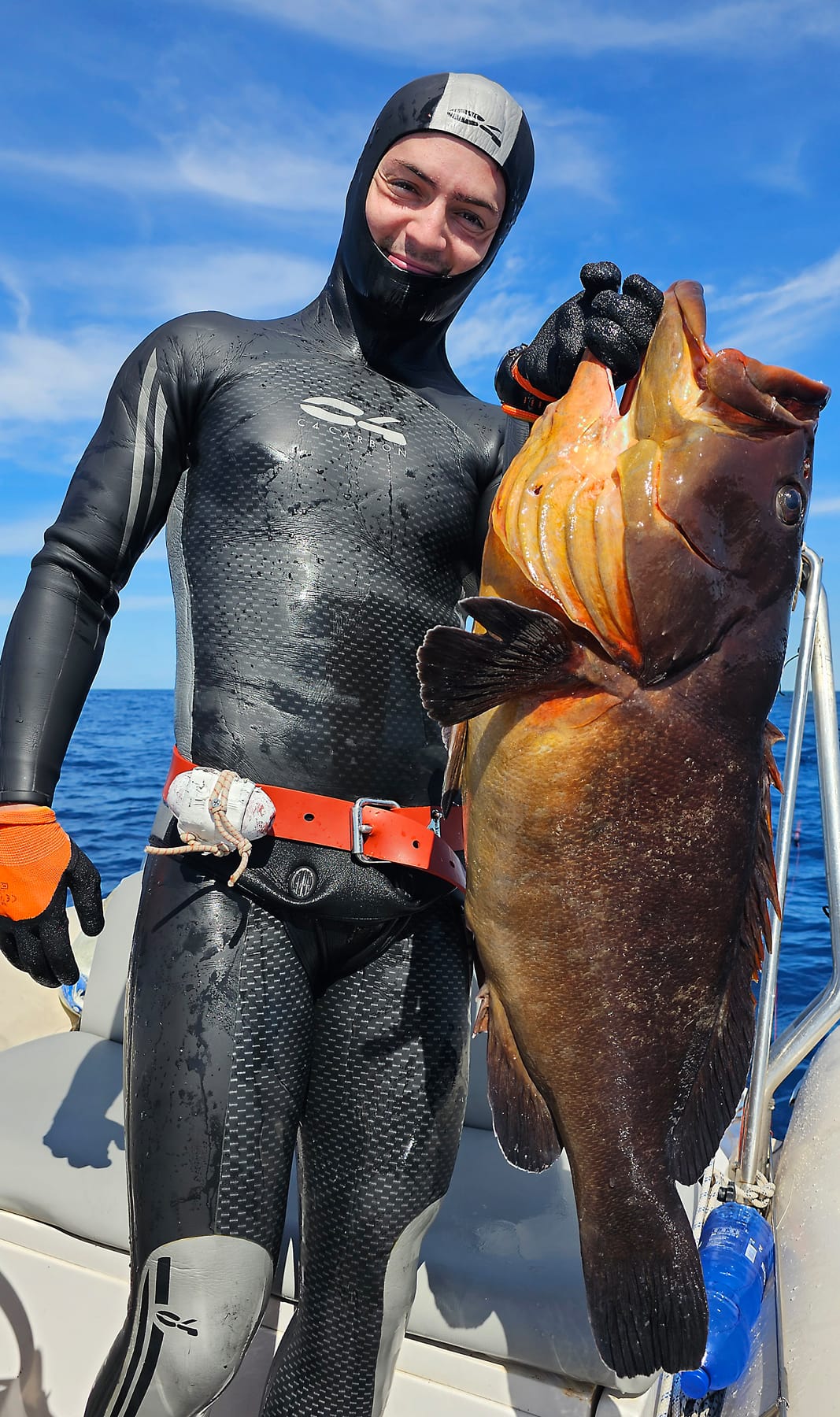
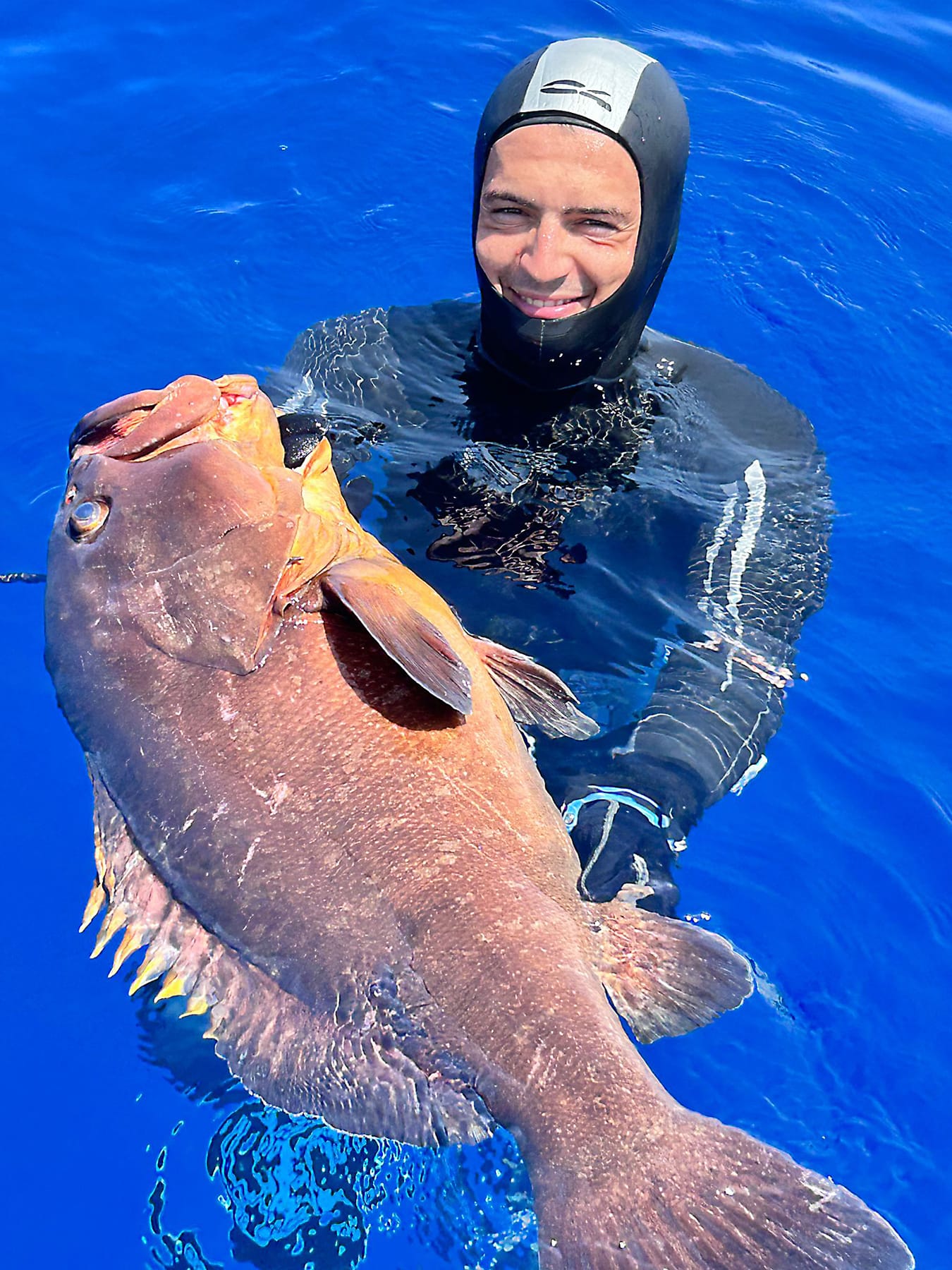
L'atleta che veste come testimonial i colori C4 con due belle cernie brune di 10 chili e 13 chili. Quest’ultima catturata al Banco Scherchi.
Una località che ha lasciato il segno? Il Banco Scherchi. Una montagna che risale da 200-400 metri, fino a sfiorare la superficie, tanto che a seconda della marea si può stare in piedi sulla sommità e respirare. Dista 60 miglia a ovest di Capo Boeo, l’estremità occidentale della Sicilia. Dal nostro porticciolo ne misuriamo 80. Comunque è un posto magico. Non vedi terra. Dormi una notte sotto le stelle. L’atmosfera è unica. Poi, i fondali sono bellissimi, variegati, ricchi di schiene, e poi, ci sono molti pesci: cernie, ancora tante e poco smaliziate. L’acqua è limpida, ma spesso la corrente può essere molto forte. Non sempre ci sono 30 metri di visibilità. Qui scesi a 28 metri su una superficie abbastanza regolare e piatta, con massi sparsi qui e là. Prima di poggiarmi vidi un banco di grossi saraghi. L’idea era di adagiarmi da qualche parte per un aspetto, ma a due metri dal fondo scorsi una cernia sotto una tettoia che mi guardava. La sparai al volo in testa, pesò 13 chili. Mollai i saraghi, era già una grande giornata.
Ricordi un episodio particolare? L’incontro col tonno. Successe a San Vito lo Capo su un fondale di 20 metri mentre ero all’aspetto. A un certo punto la mangianza impazzì e prima ancora di realizzare cosa stesse succedendo, mi passarono questi pesci davanti, vicinissimi. Io avevo il cuore in gola, ero intimorito, erano pesci di oltre 100 chili. Risalì al volo e per 15 minuti non toccai l’acqua: il cuore batteva ancora forte per lo spavento.
Parlaci della tua apnea. È una passione che esiste quasi da sempre e che nel 2021 esplose grazie al lavoro da remoto. Vista l’opportunità partì in Egitto, nel Mar Rosso, con un programma di due settimane che, folgorato dallo stile di vita dell’apneista, si estese a tre mesi raggiungendo i 61 metri di profondità. L’anno successivo a gennaio conobbi Jun Matsuno, italiano di origine giapponese, mio attuale coach, che mi trasmise gli input necessari per migliorare le tecniche di rilassamento e di mouthfill, una procedura che aiuta a portare l’aria dalla bocca alle orecchie man mano che scendi.
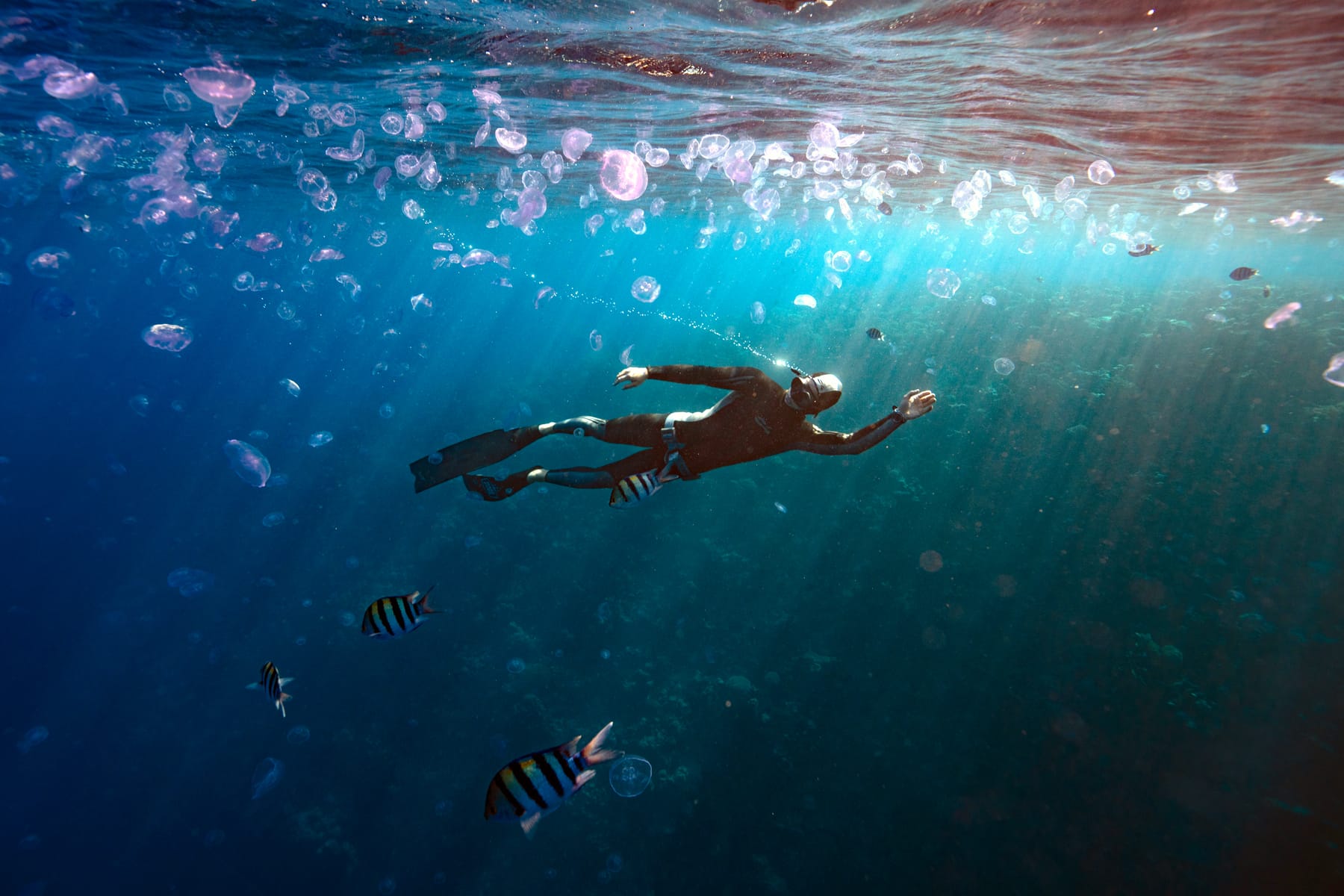
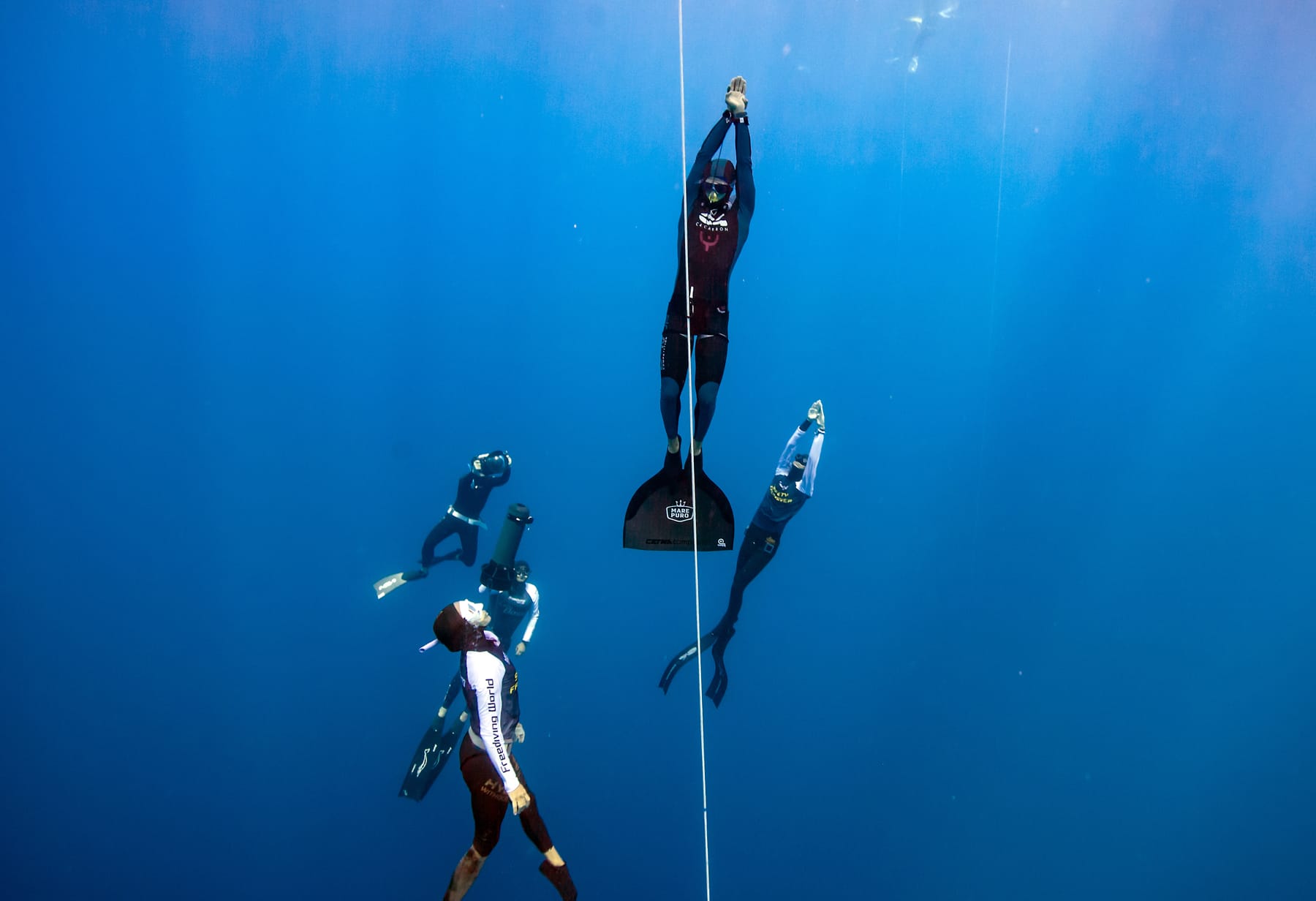
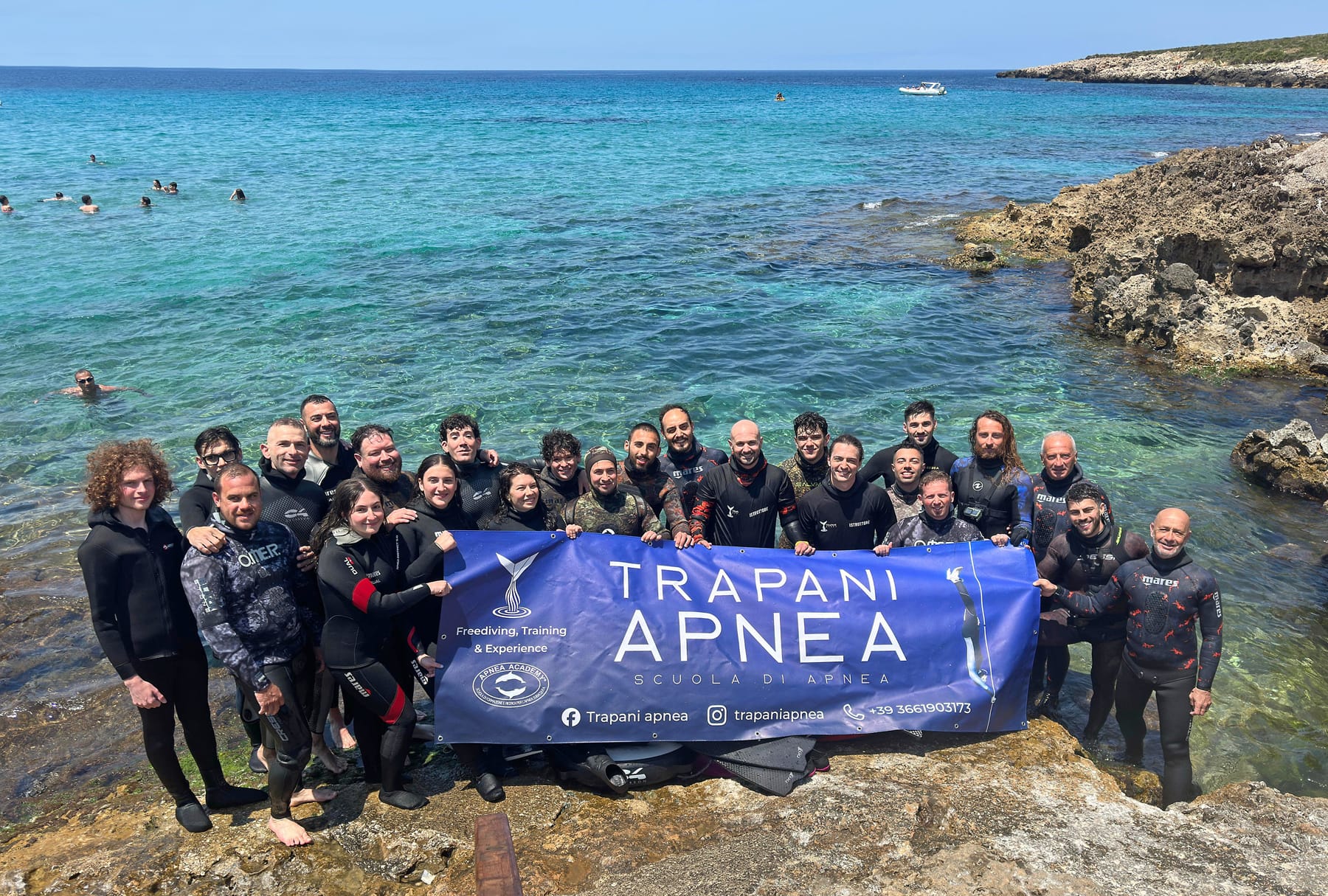
Immersione in mezzo alle meduse nel “Blue hole”, una dolina marina profonda 100 metri a Dahab in Mar Rosso. Risalita in allenamento. Allievi della scuola Trapani Apnea.
A settembre mi iscrissi alla prima gara di apnea, la Mediterranea Cup, a Cefalù. Toccai i 50 metri ma mi confrontai con atleti di più alto livello per cui non menziono la risultante classifica. Per contro a dicembre diventai istruttore Apnea Academy a Lignano e Sharm el Sheikh. Ciò mi spinse anche a creare un gruppo e così fondai l’Asd Trapani apnea che opera nella piscina comunale e che conta oggi, tra iscritti e simpatizzanti, una cinquantina di appassionati. A Sharm el Sheikh ho stabilito in assetto variabile senza pinne il record italiano Fipsas: -105 metri. Oggi, mi alleno sen-za programmi ma il prossimo inverno di sicuro parteciperò ai Campionati italiani di apnea dinamica monopinna, in vasca al chiuso.
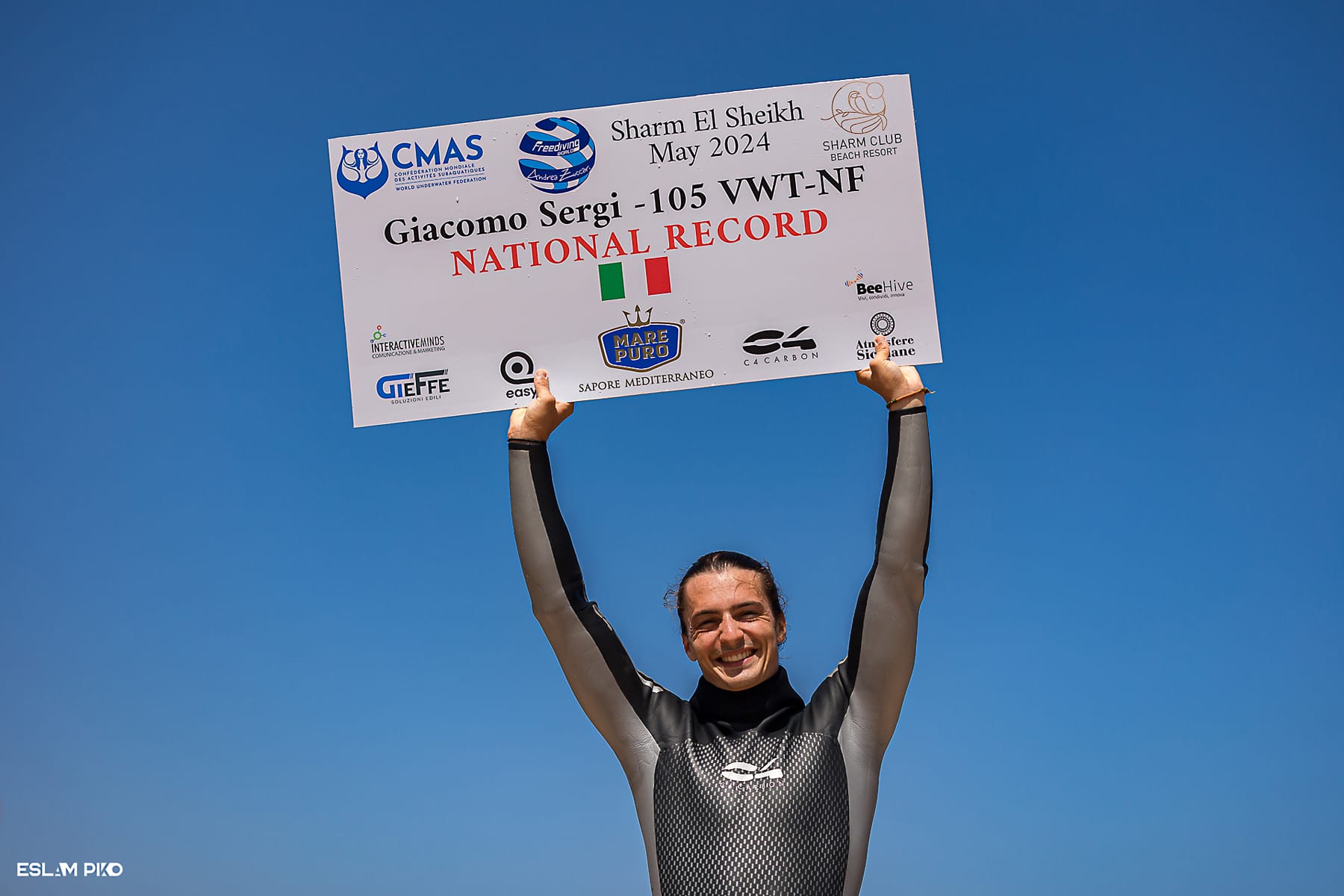

Giacomo Sergi
Water is as essential as air to Giacomo Sergi, whether he has a speargun in his hands or leaves it ashore. He talks about the two underwater passions that keep drawing him back to the blue, in the sea and in the pool.
His journey underwater began almost from his first breath, in Trapani. Born in 1996, Giacomo Sergi grew up looking out over the blue. He has always lived in this city of salt, wind and coral, with the Tyrrhenian Sea on one side and the Strait of Sicily on the other. He was just 12 when he began diving with his older brother. At 16, he started using the family’s Omer HF 75 speargun, which the two shared. Work soon took his brother away from spearfishing, so Giacomo made new friends and learned from them in the waters between Trapani and San Vito lo Capo.
What happened next?
The big thing was taking a freediving course with Francesco Nicotra through Apnea Academy. I’d just turned 18. I went in because of spearfishing and was surprised by how fascinating freediving was in its own right. I improved my breathing and relaxation and felt increasingly at ease underwater. I still went fishing with friends, although I never joined a club. Then I enrolled in engineering in Turin. I studied and sat my exams so I could spend all three summer months back down south, enjoying the sea and fishing.
At 20, I took over my uncle’s RIB, fitted it out for fishing and stopped going out from shore. I fished a few shoals at 8–12 m for seabream and small groupers. The following year I took a breath-hold spearfishing course with Fabio Amico and in 2021 I entered a qualifier. I did reasonably well, but competition didn’t grab me. Around that time, at 24 or 25, I reached 40 m in freediving.
What was the next step?
I was making steady progress, then I discovered spearfishing with a drop weight. It was like switching on a turbo. I felt as if I had almost limitless energy, and that really fired me up.
Your first memorable fish?
I can’t remember whether it was before or after that first course, but I was 18. It was summer in Marausa, where I have a place by the sea. The fishing there is usually unremarkable, but it was a beautiful day, with flat seas and clear water. I went in from shore and was lying in wait at 9–10 m. It was fairly uneventful, with the odd little seabream passing by, until a good white seabream appeared from behind a boulder to my right and came straight at me. It turned at close range and I shot it side-on, just behind the head. I shot back up to the surface, bursting with excitement. It was a lovely fish, 820 g.
Your biggest catch?
It was 2020, I was 24 and I was fishing unfamiliar ground with Posidonia and a few rocks. I made a few gliding descents while the boatman followed me and saw a fish slip into a hole at 25 m. I thought it was an 8–10 kg grouper. There was a current at the surface, I was very tired, and it was my first encounter with a fish that big. A little flustered and unsure what to do, I decided to leave it. It was too demanding for me at that point.
I came back a few days later and found my marks on the first descent, helped by a strip of sand leading right to the opening beneath the seagrass. On the way down I saw the grouper outside its hole. It immediately disappeared into the cave. I was carrying a 120 cm Calibro 12 oil-pneumatic speargun with a harpoon tip. I looked into the hole, lit up the dark cave and saw the fish at a three-quarter angle. The shot didn’t finish the job. I put tension on the line and brought it up after seven or eight dives. I was thrilled and absolutely exhausted. Most of all, I couldn’t believe how big it was. Nineteen kilos.
Which place has stayed with you?
Skerki Bank. It’s an underwater mountain rising from 200–400 m all the way to the surface. Depending on the tide, you can stand on top with your head out of the water. It’s 60 nautical miles west of Capo Boeo, the western tip of Sicily, and 80 from our little harbour. It’s a magical place. There’s no land in sight. You spend a night under the stars. The atmosphere is unique. The seabed is beautiful and varied, with plenty of ridges and fish, including lots of groupers that haven’t learned to be wary. The water is clear but the current can be very strong, and you don’t always get 30 m of visibility.
I went down to 28 m over a fairly level bottom with boulders scattered around. Before settling, I saw a shoal of large seabream and planned to lie in wait for them. Then, two metres off the bottom, I spotted a grouper looking at me from under an overhang. I shot it in the head while still descending. It weighed 13 kg. I left the seabream alone. It was already a great day.
Do you remember one encounter in particular?
The tuna. I was lying in wait over 20 m of water at San Vito lo Capo. Suddenly the baitfish went wild and, before I knew what was happening, these fish swept right past me. They weighed over 100 kg each. My heart was in my mouth. I went straight back up and stayed out of the water for 15 minutes. My heart was still pounding from the fright.
Tell us about your freediving.
It’s been a passion for as long as I can remember, and in 2021 remote working gave me a chance to throw myself into it. I went to the Red Sea in Egypt for two weeks, fell for the freediving way of life and stayed three months, reaching 61 m. The following January I met Jun Matsuno, an Italian of Japanese descent who is now my coach. He showed me how to improve my relaxation and my mouthfill, a technique that lets you use the air held in your mouth to equalise your ears as you descend.
In September I entered my first freediving competition, the Mediterranea Cup in Cefalù. I reached 50 m, but I was up against athletes at a higher level, so I’ll spare you my placing. In December I qualified as an Apnea Academy instructor, training in Lignano and Sharm el-Sheikh. That encouraged me to start a group, so I founded ASD Trapani Apnea. We use the municipal pool and now have about 50 members and supporters. In Sharm el-Sheikh I set the FIPSAS Italian record in variable weight without fins at 105 m. I’m training without a set programme at the moment, but next winter I’ll definitely compete in the Italian dynamic freediving championships with a monofin, in an indoor pool.

Commenti ()